Research Library / Comment for the Record
Comment for the Record: “The Best Metric to Reverse the Curse: A 3% Deficit-to-GDP Path to Fiscal Sustainability”


The Problem: Debt Is Growing Faster Than the Economy
CBO’s long-term projections show that the federal government’s finances are not on a stable path. Debt is set to grow without bound relative to the size of the economy.
Fiscal stability requires the debt-to-GDP ratio to be constant, or at least bounded. A government that runs a deficit and allows debt to grow every year can still be fiscally stable, as long as the economy grows at least as fast as the debt. The question is not how fast debt is growing in dollar terms, but how fast it is growing relative to GDP.
The Framework: Debt Dynamics and the Role of the Primary Deficit
The debt dynamics equation (derived in the appendix) shows that the change in the debt-to-GDP ratio depends on the primary deficit as a share of GDP, and an economic adjustment that depends on the gap between interest rates and economic growth.
The economic adjustment term captures the interaction between existing debt and financial conditions. When interest rates exceed economic growth, the existing debt compounds faster than the economy expands, pushing the ratio up. When economic growth exceeds interest rates, the economy outpaces the debt, pushing the ratio down.
The simplest case illustrates the logic clearly. If the interest rate exactly equaled the economic growth rate, the economic adjustment term would be zero. Economic growth would offset interest expense dollar for dollar, and the change in the debt-to-GDP ratio would depend entirely on the primary deficit. A primary balance would be sufficient to hold the debt-to-GDP ratio constant.
Why 3 Percent Is Approximately the Right Target
Historical financial conditions support 3 percent as a natural fiscal anchor because that deficit level implies a primary balance. Real economic growth has averaged 3.13 percent since 1948, and the real interest rate on federal debt has been in a similar range over that period. When the two rates are approximately equal, a primary balance will stabilize the debt-to-GDP ratio.
A total deficit of 3 percent of GDP is consistent with a primary balance when net interest expense equals roughly 3 percent of GDP. At moderate debt levels, this is achievable. The 3 percent target therefore has a straightforward interpretation: Congress covers all of its non-interest spending from revenues, and the interest cost on existing debt - financed by borrowing - is absorbed by economic growth.
Adjusting for Short-Run Variation
The economic adjustment term is stable over the long run, but it fluctuates year-to-year as interest rates and growth rates move. To hold total borrowing near 3 percent of GDP, the framework calls for adjusting the primary deficit to offset those fluctuations.
Figure 1 shows the combinations of primary deficit and net interest expense that are consistent with a 3 percent total deficit. The historical record shows that Congress has achieved a 3 percent target in 20 out of the last 60 years.
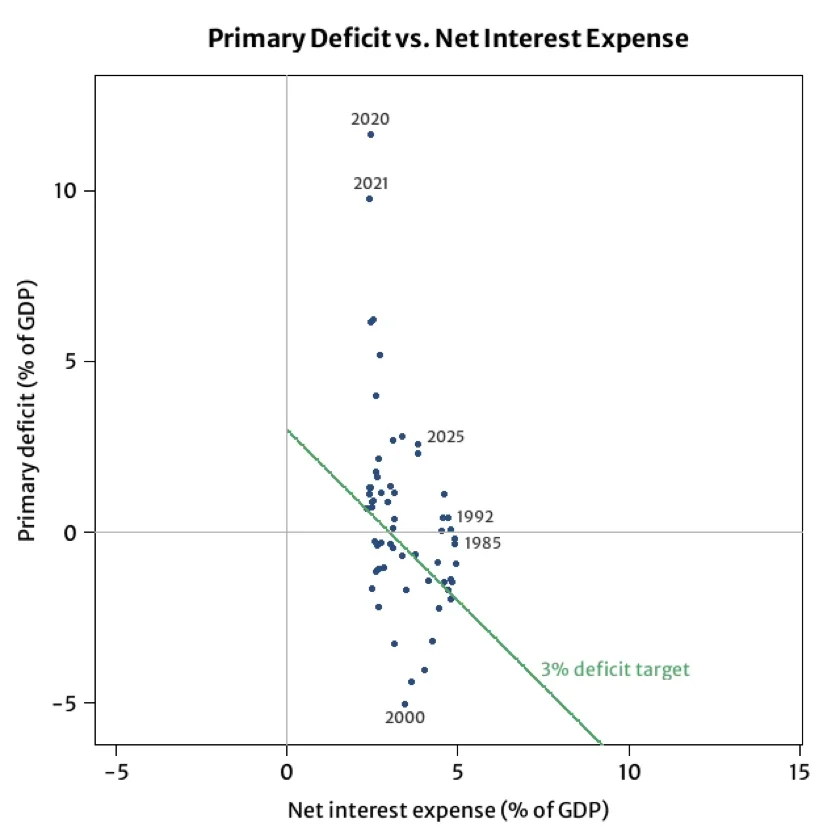
Figure 1: Primary deficit vs. net interest expense, 3% deficit constraint
When the growth-adjusted interest rate rises - for example, if interest rates spike or a recession reduces GDP - the economic adjustment term puts upward pressure on the debt-to-GDP ratio. Congress would need to run a tighter primary balance to compensate. Conversely, when growth is strong or rates fall, there is room to allow a somewhat larger primary deficit.
When Is 3 Percent Not Enough?
The 3 percent target assumes that economic growth will remain near its historical average. If real growth were to slow for structural reasons, the deficit would need to shrink to match the new pace of the economy.
Congress does not directly control interest rates, inflation, or long-run growth. But Congress should be aware that its fiscal choices affect market conditions. Persistent large deficits can push up interest rates, slow growth through crowding out, or trigger inflation - all of which make the fiscal situation worse, not better.
A Deficit Target Requires a Companion Debt Target
A deficit target is necessary but not sufficient. Congress should also adopt a debt target, because the level of debt determines how much of any future deficit is consumed by interest expense - and therefore how much fiscal room remains for primary spending and tax policy.
The mechanism is straightforward. High debt raises interest costs. Rising interest costs crowd out primary spending or require tax increases. Distortionary taxes on labor and capital income reduce economic growth, which in turn makes it harder to hold the debt-to-GDP ratio stable. If Congress is unwilling or unable to raise taxes, persistently high debt and deficits force the burden onto monetary policy.
The question is therefore not whether federal debt will eventually be stabilized, but whether it will be stabilized through deliberate fiscal adjustment or through the hidden tax of rapid inflation.
A deficit target of 3 percent holds debt roughly stable at whatever level it currently sits. A companion debt target limits the risk to the government from spikes in interest rates and the risk to the public from inflation eroding the real value of the debt.
Conclusion
Under historical financial conditions, a 3 percent deficit is approximately consistent with a primary balance. Revenues cover all spending except interest on existing debt, and economic growth absorbs the cost of servicing that debt. Congress should treat 3 percent as the long-run anchor and adjust the primary deficit year to year as financial conditions require. That target is most durable when paired with a debt target that gradually reduces the share of the deficit consumed by interest.
Appendix: The Debt Dynamics Equation
The change in the debt outstanding is total federal expenditures less total federal revenues,

where Dt is total federal debt outstanding, g represents the ratio of primary federal spending to nominal GDP, τ represents the share of nominal GDP collected in taxes, and i is the nominal interest rate on the debt.
Nominal GDP is the product of the aggregate price level and real output. Real output is determined by a production function that depends on the capital stock, the amount of labor, and total factor productivity. For simplicity, assume that capital and labor grow at the same rate so that the capital-to-labor ratio stays constant. The nominal GDP growth rate is then
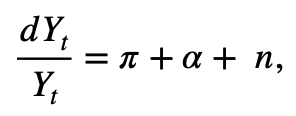
where Yt is nominal GDP, π is the inflation rate, α is the rate of productivity growth, and n is the rate of population growth. Again for simplicity, assume that the growth rates are constant.
Under this setup, the debt-to-GDP ratio changes over time according to
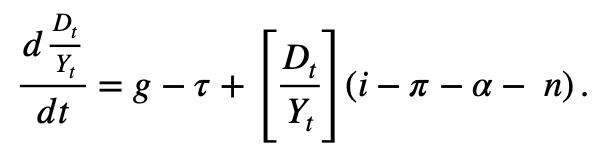
The first part, g - τ, is the primary deficit. If the federal government runs a primary surplus, then this term is negative and contributes to reducing debt. The second part is the growth-adjust interest expense. It tracks the effective interest expense for the federal government after accounting for economic growth. When real interest rates are higher than economic growth, carrying previously issued debt incurs an expense. When real interest rates are lower than economic growth, the debt to GDP ratio will tend to fall on its own.