The Price Level


Money is the medium of exchange that makes modern-day trade possible. Consequently, the value of money - its purchasing power - is a key economic indicator that Congress needs to track.
The value of money is measured by the price level. This primer explains the price level so staffers can recognize its role in both technical budget scores and headline economic debates.
What Is the Price Level?
The price level is an average of prices for a basket of goods and services. Within the basket, the individual prices will not change all at the same time. By weighting and averaging the individual price changes, the price level captures not one good becoming more expensive relative to another, but trends that are common to all prices becoming more expensive relative to the dollar.
Thus, the inverse of the price level measures changes in the value of the medium of exchange, or the dollar’s purchasing power. An increase in the price level is the same as a decrease in the value of a dollar. Similarly, a decrease in the price level is the same as an increase in the value of a dollar.
For example, suppose a basket of goods consists of bread, milk, and eggs. A price index would start by defining the quantities of each good in the basket and finding the total cost.
| Item | Quantity | Price | Total |
|---|---|---|---|
| Bread | 5 loaves | $2.00/loaf | $10.00 |
| Milk | 3 gallons | $3.00/gallon | $9.00 |
| Eggs | 2 dozen | $2.50/dozen | $5.00 |
| Total | $24.00 | ||
| Price Index | 100 |
The cost of the basket is expressed as an index. One year is chosen as the base year, and the index in that year is set to 100. The units on the index are not absolute. That is, a price index only shows the relative change in prices between time periods, which is why price indexes are often reported as measures of inflation.
Is the Price Level the Same As Inflation?
Inflation is the rate of increase in the price level. The relationship between the price level and inflation is the same as between a car’s position and speed. A price level with zero inflation is like a stationary car. The inflation rate measures how fast the price level is growing, just as a car’s speed measures how fast it is moving.
| Item | Quantity | Price | Total |
|---|---|---|---|
| Bread | 5 loaves | $2.10/loaf | $10.50 |
| Milk | 3 gallons | $3.15/gallon | $9.45 |
| Eggs | 2 dozen | $2.70/dozen | $5.40 |
| Total | $25.35 | ||
| Price Index | 105.6 |
The index is a single number that grows at the same rate as the total cost of the basket. Suppose that we revisit our example and find that prices have increased. Because the same basket costs 5.6% more, the price index rises to 105.6.
A reduction in inflation is called disinflation. A decrease in inflation just means that prices are growing more slowly, not that they have come down. When the price level falls, that’s called deflation.
Which Data Series Measures the Price Level?
In practice, there are several economic data series that could be used as the price level. The series differ primarily by choosing different baskets of goods to average prices. Prominent price indexes include:
- Consumer Price Index (CPI). The CPI basket represents the consumer goods purchased by the average household in the United States.[1]
- Personal Consumption Expenditures (PCE) Price Index. The PCE price index uses a measure of household spending reported in the National Income and Product Accounts. This basket includes many items that affect household standard of living but aren’t purchased directly, such as employer-provided health insurance.[2]
- Core CPI and PCE Price Index. Core measures of inflation exclude food and energy costs because their prices are often volatile. Core price indexes are often cited as a measure of the trend in inflation.
- Producer Price Index (PPI). PPI is used to produce measures of the real value of goods and services produced in the United States. Several different indexes track price increases at different stages of production.[3]
- Gross Domestic Product (GDP) Price Index. The GDP price index measures changes in the price of final goods and services produced in the United States. This includes sales to businesses, sales to governments, and exports and excludes imports.[4]
Despite their differences, all of the price indexes capture similar trends in inflation. Figure 1 shows that major swings in inflation affect all price indexes at the same time. Yet, differences in how the series are constructed mean the series are not in perfect alignment.
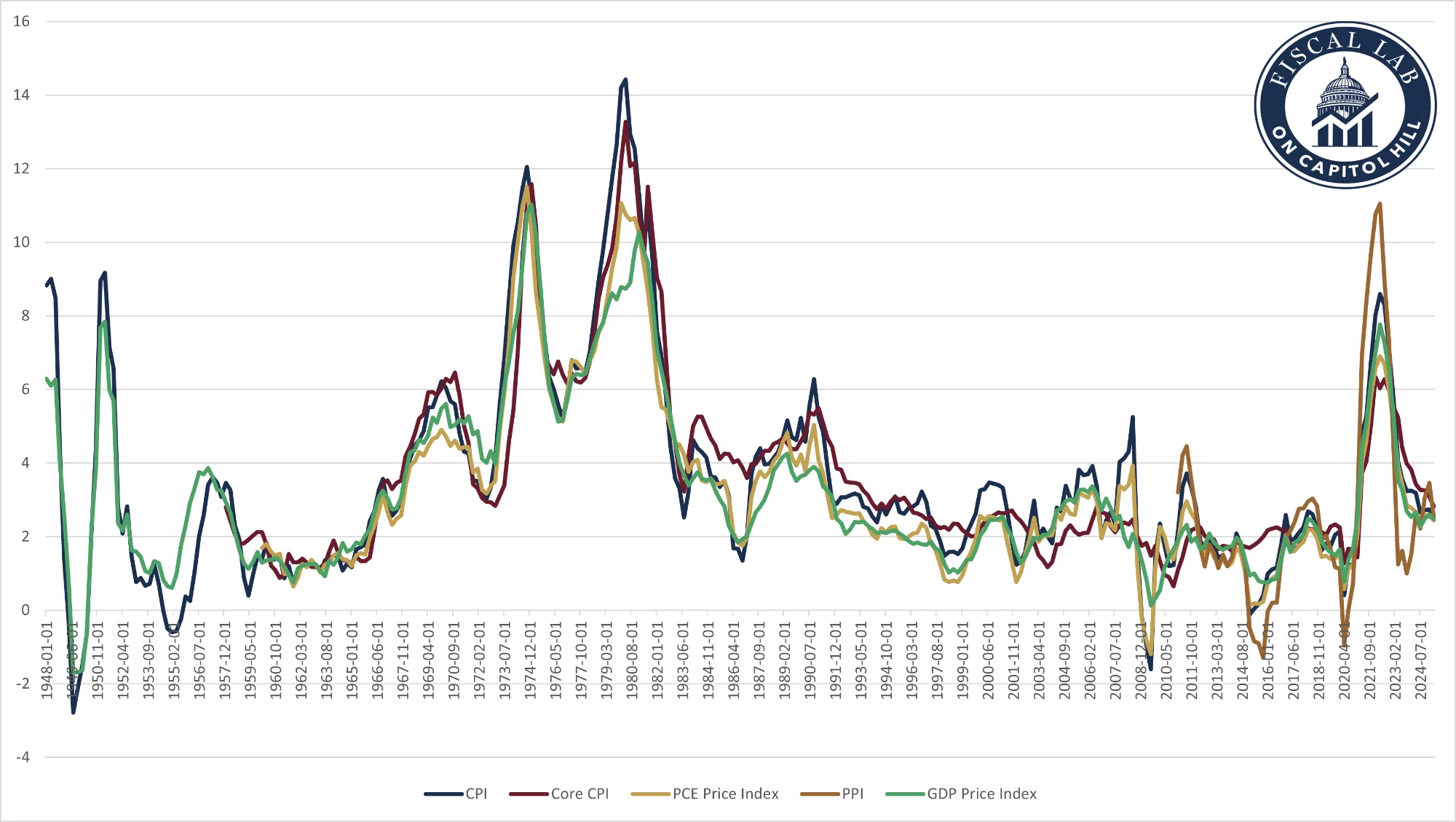
Inflation measures: headline CPI (CPIAUCSL), core CPI (CPILFESL), PCE price index (PCEPI), producer price index for finished goods (PPIFIS), and GDP deflator (GDPCTPI). Source: FRED.
Economic models, such as those used by the Fiscal Lab or the Congressional Budget Office (CBO), simplify an economy with many goods to a single composite consumption good (or a small number of composite goods). Unless specified, the models used try to capture the abstract relative value of money to goods and services that is approximated by the separate indexes.
Is the Price Level the Same Thing As the Cost of Living?
The cost of living measures the dollar cost to buy a given level of happiness. Economists measure happiness with a utility function, which is a theoretical construct where a consumer assigns rankings to consumption bundles that are more preferable.[5]
There are two problems with producing a true cost of living measure. First, utility functions are subjective. People may rate goods and services differently from one another, and so would assign different values in the cost of living associated with the same set of price changes. Second, utility functions are difficult to measure because they are not directly observable.
There is an additional aspect of the cost of living that is not captured by price indexes with a fixed basket of goods, such as the CPI. When prices on one good go up faster than others, consumers will substitute the more expensive good for less expensive goods. Thus, fixed-basket indexes show a substitution bias that tends to overstate the cost of living. Notice in Figure 1 above that the CPI averages slightly higher than other price indexes and peaks higher during times when prices are changing faster.
What Is the Difference Between Real and Nominal Data?
Money is only a medium of exchange. That is, most people exchange their time for money and then their money for goods. Money just helps the exchange of time for goods. In most cases, when the value of the dollar falls, it offsets both sides of the exchange, leaving the amount of time needed to buy goods and services unaffected. A rising salary in dollars doesn’t translate to a higher standard of living if salaries just keep pace with increases in the price level.
The primary use of price indexes is to correct economic data for changes in the value of the dollar. Nominal series report the value in dollars while including changes in the value of the dollar. A nominal value can be converted to a real value using the following formula:

where t is a target year and r is a reference year.
For example, median household income was $22,420 in 1984 and $83,730 in 2024. Using nominal values, it looks like the typical household’s income grew by 273% over that time period. However, the CPI[6] rose from 160.2 to 462.5. Using the formula above, $22,420 in 1984 dollars had the purchasing power of $22,420 x 462.5/160.2 =$64,726 in 2024 dollars.[7] Using real figures show that the typical household’s purchasing power grew by 29.3 percent while the value of the dollar fell by 65.3 percent.
Why Should Congress Care About the Price Level?
Many parts of federal law specify dollar amounts that are adjusted with changes in a price index. For example, Social Security payments are automatically increased to keep pace with increases in the CPI.[8]
Choosing the right price index determines whether policies remain stable or creep upward in real terms. When Congress adjusts a policy using an index that overstates living costs, that policy grows more generous each year in real dollars. Or framed differently, switching to an index that tracks the cost of living could reduce outlays without disadvantaging the program’s population.
Indexing payments changes the flow of payments going out each year, but inflation also erodes the outstanding real value of dollar-denominated assets, including Treasury debt. Bondholders effectively pay a tax as their holdings lose purchasing power while borrowers effectively benefit as the real cost of their debt falls. The arbitrary redistribution of wealth is one of the major economic distortions introduced by variable and unexpected inflation.
Congress should care about the price level because it determines whether laws work as intended. Even though many public policies and parts of the economy work with nominal dollar amounts, households ultimately care about the purchasing power of those dollars. If nominal incomes and program costs keep up with changes in the price level, then households can maintain their standard of living.
Notes
- For more detail, see Bureau of Labor Statistics, “Consumer Price Index: Concepts” in Handbook of Methods, last modified April 10 2025. ↩
- For more information, see Bureau of Economic Analysis, NIPA Handbook: Concepts and Methods of the U.S. National Income and Product Accounts, chapter 5: “Personal Consumption Expenditures,” 5 - 10. ↩
- For more information, see the Bureau of Labor Statistics, “Producer Price Indexes: Concepts” in Handbook of Methods, last modified July 31, 2025. ↩
- The GDP price index is conceptually the same as the GDP deflator, but calculated differently. For a comparison of different price indexes, see Bureau of Economic Analysis, “Quick Guide: Some Popular BEA Price Indexes,” last modified November 21, 2023. ↩
- For more information, see Jerry A. Hausman, “Sources of Bias and Solutions to Bias in the Consumer Price Index,” Journal of Economic Perspectives 17, no. 1 (Winter 2003): 23 - 44. ↩
- The CPI value for this calculation is the R-CPI-U-RS. It retroactively calculates the CPI-U using current methods to control for methodological changes in how the CPI has been constructed. For more detail, see Bureau of Labor Statistics, “Consumer Price Index,” last modified March 21, 2025. ↩
- Similarly, the 2024 figure can be converted to 1984 dollars by choosing 1984 as the reference year and 2024 as the target year. ↩
- Social Security Administration, “Application of COLA to a Retirement Benefit,” accessed October 24, 2025. ↩