How a Large Fed Balance Sheet Complicates Congressional Budget Choices


Recent criticism of the Federal Reserve’s interest on reserves (IOR) policy has sharpened debate about the central bank’s role in the economy. Critics contend that paying interest on reserves subsidizes banks and costs taxpayers billions in forgone revenue. That criticism identifies a real cost but doesn’t address the underlying issue: The Fed’s large IOR expense is a symptom of its vastly expanded balance sheet. By holding a large amount of Treasury debt, the Fed has reshaped its relationship with fiscal policy in ways that threaten its ability to control inflation.
Before the 2008 Financial Crisis, the Fed operated with a relatively small balance sheet and targeted only short-term interest rates through routine open market operations. The crisis forced the Fed to make large-scale asset purchases that flooded the banking system with reserves. Had banks used those reserves to create more loans, they would have driven up inflation, so the Fed paid interest to keep the funds parked in the banking system.
The shift to a large balance sheet managed with IOR created five critical problems. First, it drew the Fed into debt management functions traditionally reserved for Treasury. Second, it shifted fiscal risk onto taxpayers through losses on the Fed’s asset holdings. Third, it created a conflict of interest, as the Fed both profits from and sets interest rates. Fourth, it muted market signals about fiscal sustainability, allowing Congress to run large deficits without apparent consequences. Fifth, it constrained the Fed’s ability to fight inflation - raising the risk of fiscal dominance, where financing needs override the inflation mandate.
The IOR debate, in other words, mistakes the symptom for the disease. What follows traces how the current framework developed, why it creates fiscal risks, and what a durable solution would require.
The Pre-Crisis Framework Separated Monetary and Fiscal Policy
In a fractional reserve banking system, banks take deposits and make loans against those deposits. When they make loans, they add to the money supply. The fraction of the deposits banks keep in reserve determines the total money supply.
Banks keep reserves so that they can meet depositors’ needs for withdrawal. Before the 2008 crisis, the Federal Reserve required a minimum amount to ensure that banks’ operating losses would not prevent them from being able to repay depositors. However, because banks make income by loaning money, they don’t want to hold more reserves than what’s needed to satisfy depositors. Excess reserves balances were typically small, usually around $2 billion dollars in total.[1],” dataset for 1984 - 2020, accessed December 13, 2025.]
Reserve requirements created a market for overnight loans between banks in order to satisfy the regulations. Banks with extra reserves would lend to banks that needed to satisfy the minimums. The interest rate in the federal funds market was the main monetary policy tool of the Federal Reserve. The Fed controlled that rate by open market operations - buying and selling short-term Treasury bonds or bills out of its own accounts. When the Fed bought bonds, it paid for them by creating new reserves, adding to the supply in the federal funds market. When the Fed sold bonds, it collected reserves, subtracting from the supply in the federal funds market.
Reserves were scarce, so banks could expand their lending if they could obtain additional reserves. But any remaining unfunded lending opportunities would only be profitable if banks could borrow additional reserves at a lower rate. Thus, open market operations that added reserves pushed interest rates down and vice versa. The Fed used overnight repurchase agreements to make short-term adjustments in the federal funds market that could easily be reversed. It made permanent sales in order to match the long-term growth in the economy.
The Fed’s operations were also deliberately limited in scope. It held and traded only Treasury debt and targeted interest rates only in the overnight market. Its actions had no effect on default risk and term risk premia in other debt markets.
The narrow focus reflected an important institutional principle to separate monetary and fiscal policy. The separation is necessary because politicians face strong incentives to expand the money supply for short-term political gain. Printing money faster than necessary to match the growth in the economy results in more inflation, so control of the money supply is outsourced to a central bank with a long-term focus on the price level.
Crisis-Era Asset Purchases Erased That Separation
The Financial Crisis of 2007 - 2009 put this arrangement to the test. The crisis started when a correction in the housing market created the potential for losses at many financial institutions holding related mortgages and mortgage-backed securities. The sharp increase in default risk produced large drops in the prices of those securities, which affected their value as collateral in overnight markets. Because market participants lacked information on the true underlying value of assets, lending activity froze. Had those potential losses been realized, it could have wiped out the equity of some banks, leaving institutions with good collateral unable to repay their depositors due to temporary illiquidity.
The Fed’s initial response was to push the interest rate in the federal funds market as low as it could, all the way down to zero. Even that proved insufficient to fully stabilize markets, so the Fed expanded its toolkit to target longer-term interest rates as well. It implemented a Large-Scale Asset Purchase (LSAP) program to buy longer-term Treasury debt and mortgage-backed securities. These large-scale asset purchases removed the default risk and the term risk from the market and brought it onto the Fed’s books.
The consequence of these large-scale asset purchases was to flood the federal funds market with reserves. Banks ended up with more reserves than they needed, which pushed interest rates to zero. In fact, the Fed had deliberately overshot, ensuring that no financial institution would fail for lack of liquidity. But that excess meant that marginal changes in the supply of reserves had nearly no effect on the federal funds rates because reserves were abundant.
However, the Federal Reserve’s response had inadvertently surrendered its primary tool to implement monetary policy. The Fed flooded the system with liquidity in order to give banks a cushion to ensure that depositors were repaid. But without interest on those reserves, banks would lend them into the broader economy to chase a return. Cheap, abundant credit would have driven inflation as businesses rushed to borrow. Paying interest on reserves kept those funds anchored within the Federal Reserve System rather than flowing freely into the economy.[2]
Figure 1. Monetary policy regimes
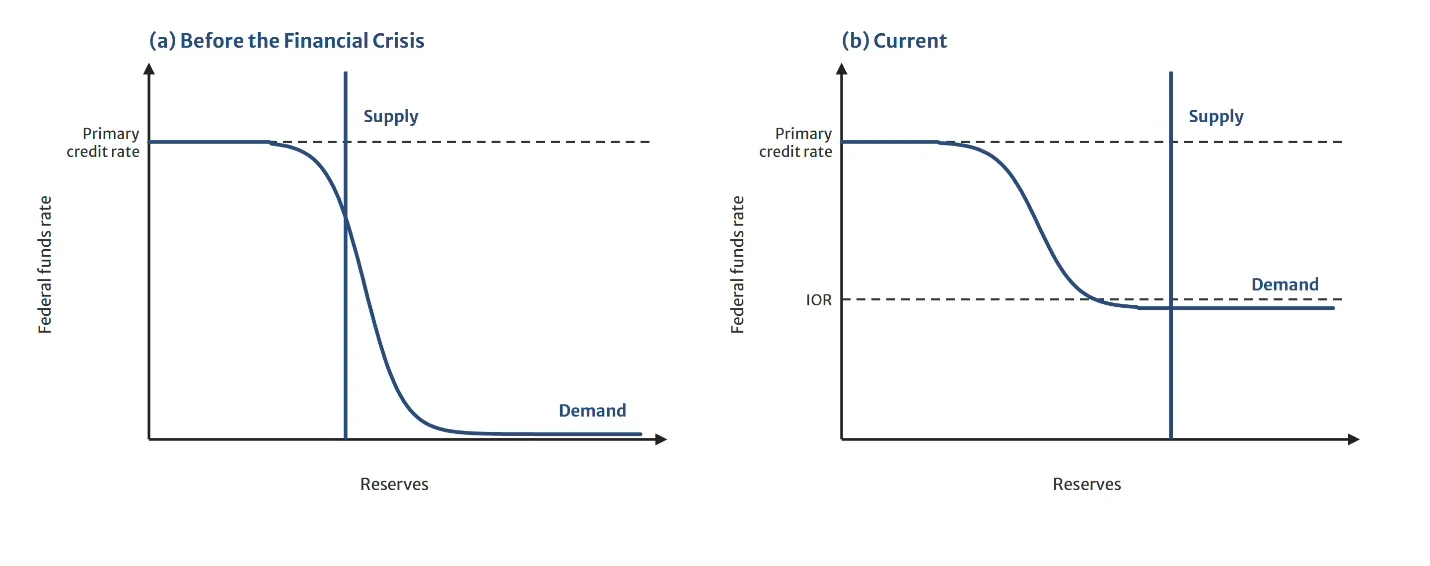
Source: Ihrig, Meade, and Weinbach (2015)[3]
Figure 1 shows the shift in operating regime graphically. The demand for reserves follows an S shape, with three key sections. There is a ceiling on demand even if reserves are very scarce because banks can borrow directly from the Fed at the primary credit rate. There is a floor on demand at zero. In between, there is a downward-sloping demand curve where banks are willing to borrow additional reserves at lower interest rates. In the current regime, the supply of reserves has shifted so far to the right that it pushes demand all the way to the floor. Thus, the Fed offers to pay interest on reserves, which raises the floor and lets the Fed set a target for the federal funds rate.
The shift to an ample reserves regime created an expense for the Federal Reserve where none had existed before. Table 1 shows the magnitude of that cost using a stylized example. The cell values show interest flows between the Treasury, the Fed, and the market in four cases. In all cases, there is $30 trillion in debt held by the public and the average rate on Treasury debt is 3.5 percent. There are two different cases for the rate on reserves (low, 0.5 percent; high, 5.5 percent) and two more for the size of the Fed’s Treasury holdings (normal, $500 billion; large, $4,500 billion). Reserve balances at the Fed also change with the balance sheet (normal, $50 billion; large $4,050 billion).
Table 1. Stylized interest flows
| Normal, Low | Normal, High | Large, Low | Large, High | |
|---|---|---|---|---|
| Treasury to Market | $1,033 | $1,033 | $893 | $893 |
| Treasury to Fed | $18 | $18 | $158 | $158 |
| Fed to Market | $0* | $3 | $20 | $223 |
| Fed to Treasury | $17 | $15 | $137 | -$65** |
| Net to Treasury | $1,033 | $1,035 | $913 | $1,115 |
Dollar figures are in billions.
* Less than 0.5 rounded down.
** When the Fed loses money on operations, it stops remittances and records a deferred asset. The Fed pays back the deferred asset balance before resuming remittances. That is, current losses are offset by reductions in future remittances.
A larger balance sheet increases the volatility of the net interest cost to the Treasury. If short-term and long-term rates are roughly the same, then the net cost is independent of the size of the balance sheet. With a historically normal balance sheet, the swing between high and low short-term rates only changes the net by about $1 billion per year. With a large balance sheet of the size in recent years, that same interest rate change produces a $100-billion-a-year swing - roughly the size of the Supplemental Nutrition Assistance Program.
Paying interest on a small reserve base would have been manageable, but the system now holds reserves at a far larger scale. The new regime gives the Fed valuable flexibility to change the supply reserves without lowering interest rates. But that flexibility comes at the cost of reduced remittances to the Treasury, which reduces receipts in the congressional budget process. Fortunately, additional income offsets some of that expense. The Fed has effectively expanded its banking activities, converting holdings of long-term, illiquid Treasury debt into short-term liquid reserves. Under favorable conditions, this generates profits and therefore larger remittances to the Treasury. However, when short-term rates rise above the rates on the Fed’s assets, the same mechanism produces losses.
Five Ways the Large Balance Sheet Distorts Fiscal Policy
The larger balance sheet and volatile remittances mean the conduct of monetary policy has a larger effect on Congress’s choice of fiscal policy. This entanglement distorts fiscal policy in five ways.
First, the Fed’s maturity transformation as a bank potentially conflicts with Treasury’s debt management. By buying long-term debt with reserves, the Fed has effectively exchanged fixed rate federal debt for floating rate federal debt. This is the basic business of a bank, to transform long-term debt into short-term debt and profit on the difference. But the Fed sends its profits to the Treasury, so the Fed’s balance sheet is effectively an extension of the federal government’s balance sheet. As the Fed’s balance sheet gets larger, it competes more with Treasury’s management of federal liabilities.
Second, the larger balance sheet also invites conflict with Treasury’s risk management. The Federal Reserve’s large-scale asset purchases reduced risk in the financial sector by swapping riskless reserves for risky assets, such as mortgage-backed securities. But that swap did not reduce the overall level of risk in the economy. It merely transferred the risk from the private sector to the Fed. Taxpayers now bear that risk because losses on the Fed’s portfolio reduce its remittances to the Treasury.
Third, when the Fed supports the price of federal debt, it mutes market signals about the sustainability of the government’s finances. Congress has run large deficits in recent years, averaging 6.3 percent of GDP since 2009,[4] as Percent of Gross Domestic Product [FYFSGDA188S],” dataset for 1929 - 2025, accessed December 14, 2025.] while real GDP growth has averaged merely 2.2 percent per year over the same period. Deficits that eclipse real GDP growth will require the private market to buy larger amounts of federal debt. Debt markets provide signals to the federal government about the feasibility of its financial plans. Falling prices (rising rates) indicate that markets see higher default risk or inflation risk with federal debt. Stable prices for federal debt leave Congress with the impression that large federal deficits are sustainable.
Fourth, the Federal Reserve is like a bank in that it profits from the spread in interest rates. Unlike other banks, however, it has the ability to influence rates, which creates a conflict of interest. A larger balance sheet makes the Fed a more attractive target for political pressure because its rate-setting decisions have a bigger effect on federal borrowing costs and remittances.
Fifth, even if the Fed resists political influence, the Fed may lose the ability to control inflation without a fiscal correction. Congress’s insistence on running large deficits places the Fed in a bind. The Fed could raise rates to control inflation, which would both slow real economic activity and kick off a debt spiral. As the Fed’s balance sheet grows, the potential for losses makes the choice to raise rates even harder, as higher rates raise expenditures on interest on reserves. Alternatively, it could lower rates to sustain real economic activity and generate remittances for the Treasury, but at the cost of allowing inflation to rise above the target. A situation where large fiscal deficits force the Fed to print money and allow higher inflation is called fiscal dominance.
The prospect of fiscal dominance shifts market expectations about whether the government will inflate away the debt. If the market doubts the government’s ability to repay the debt in real terms, then it will try to unload the debt. Prices on debt will fall, and the Fed will either buy the debt to keep prices high and rates low, or let banks take losses, which just recreates the situation from the Financial Crisis. Large-scale asset purchases only kick the can down the road. The only way out of fiscal crisis is to balance revenues and expenses across the government.
Balancing the Budget Creates the Policy Space to Shrink the Balance Sheet
Unwinding the Fed’s large balance sheet would clarify the separation between monetary and fiscal policy that motivates granting a central bank independence to maintain low inflation. Reducing the budget deficit gives the Fed space to reduce its holdings of federal debt without disrupting the economy. A smaller balance sheet would reduce the policy conflicts that favor higher inflation and risk a debt crisis, while making federal interest expenses less volatile.
The abundant reserves regime gives the Fed separate tools to address inflation and liquidity. After the acute crisis passed, the Fed stopped using its balance sheet to withdraw that liquidity. The federal government has not completed its response to the 2008 Financial Crisis. That response should have been a 1-2 punch of quick action by the Fed and long-term fiscal correction by Congress.
Instead, the Fed continues papering over problems in financial markets, while Congress carries on as if nothing requires attention. The flood of reserves pushes down yields on long-term debt, which lets Congress delay the hard work of fiscal consolidation. The longer Congress delays, the more the market will price in the possibility that Washington lacks the will to balance the budget and instead intends to inflate the debt away. Until policymakers unwind the original response to the crisis, we will see inflationary pressures or elevated chances of a debt crisis.
Notes
- Federal Reserve Bank of St. Louis, “Excess Reserves of Depository Institutions (DISCONTINUED) [EXCSRESNW ↩
- Congress had granted authorization for IOR in the Financial Services Regulatory Relief Act of 2006 to take effect in 2011, but in response to the Financial Crisis, the Emergency Economic Stabilization Act of 2008 accelerated its implementation. For more information, see “Interest on Reserves,” Federal Reserve History, December 12, 2025. ↩
- Jane E. Ihrig, Ellen E. Meade, and Gretchen C. Weinbach, “Monetary Policy 101: A Primer on the Fed’s Changing Approach to Policy Implementation,” Finance and Economics Discussion Series 2015-047, July 2015, Board of Governors of the Federal Reserve System. ↩
- Federal Reserve Bank of St. Louis, “Federal Surplus or Deficit [- ↩