The Cost of Delay: How Washington’s Fiscal Failures Are Reaching the American Consumer


Brief
- Federal fiscal failures are already reaching households through higher borrowing costs, elevated prices, and growing pressure on mortgage, auto, and consumer credit expenses.
- Continued delay raises the risk that Americans will receive less while paying more, as rising interest costs crowd out other priorities, and programs such as Social Security face abrupt benefit reductions.
- Congress still has a choice: Deliberate fiscal reform can phase in changes and protect vulnerable households, while continued inaction makes the eventual adjustment sharper, less predictable, and more disruptive.
Government shutdowns, $40 trillion in federal debt, trillion-dollar deficits, and constant political gridlock have become familiar headlines in Washington. But too often, those headlines fail to address the consequences already reaching American households. The real story is not simply the size of the federal debt or another fight over government funding. It is the growing pressure these failures place on family budgets through higher prices, increased borrowing costs, and the growing risk that households will receive fewer benefits and services in the years ahead.
Persistent federal deficits can add to inflationary pressure and make it more difficult to restore price stability. For American households, the consequence is straightforward: Their purchasing power is eroded as the cost of housing, healthcare, education, food, fuel, and other necessities rises. When prices rise faster than incomes, families can find themselves in a weaker financial position because more of each paycheck is required simply to maintain the same standard of living.
Recently, the Federal Reserve has also raised interest rates in an effort to contain inflation, increasing borrowing costs across the economy. For consumers, that means higher rates on credit cards, auto loans, and other forms of credit. For mortgages, the effect has been twofold. First, higher interest rates and Treasury yields translate into higher mortgage rates, raising the cost of borrowing for future homeowners. Second, mortgage rates have also remained unusually elevated relative to Treasury yields. Historically, 30-year mortgage rates have averaged roughly 150 basis points above the 10-year Treasury yield; more recently, that spread has been closer to 200 basis points. Together, these pressures mean that even when home prices remain unchanged, families can face significantly higher monthly payments simply because the cost of financing the same house has increased.
Higher borrowing costs are only one part of the risk facing consumers. As deficits and interest expenses continue to grow, the federal government will have less room to fund other priorities, while major benefit programs face their own long-term financing pressures. That creates a second source of pressure on households: Americans may not only pay more to borrow and maintain their standard of living but may also receive less from programs they have spent years planning around.
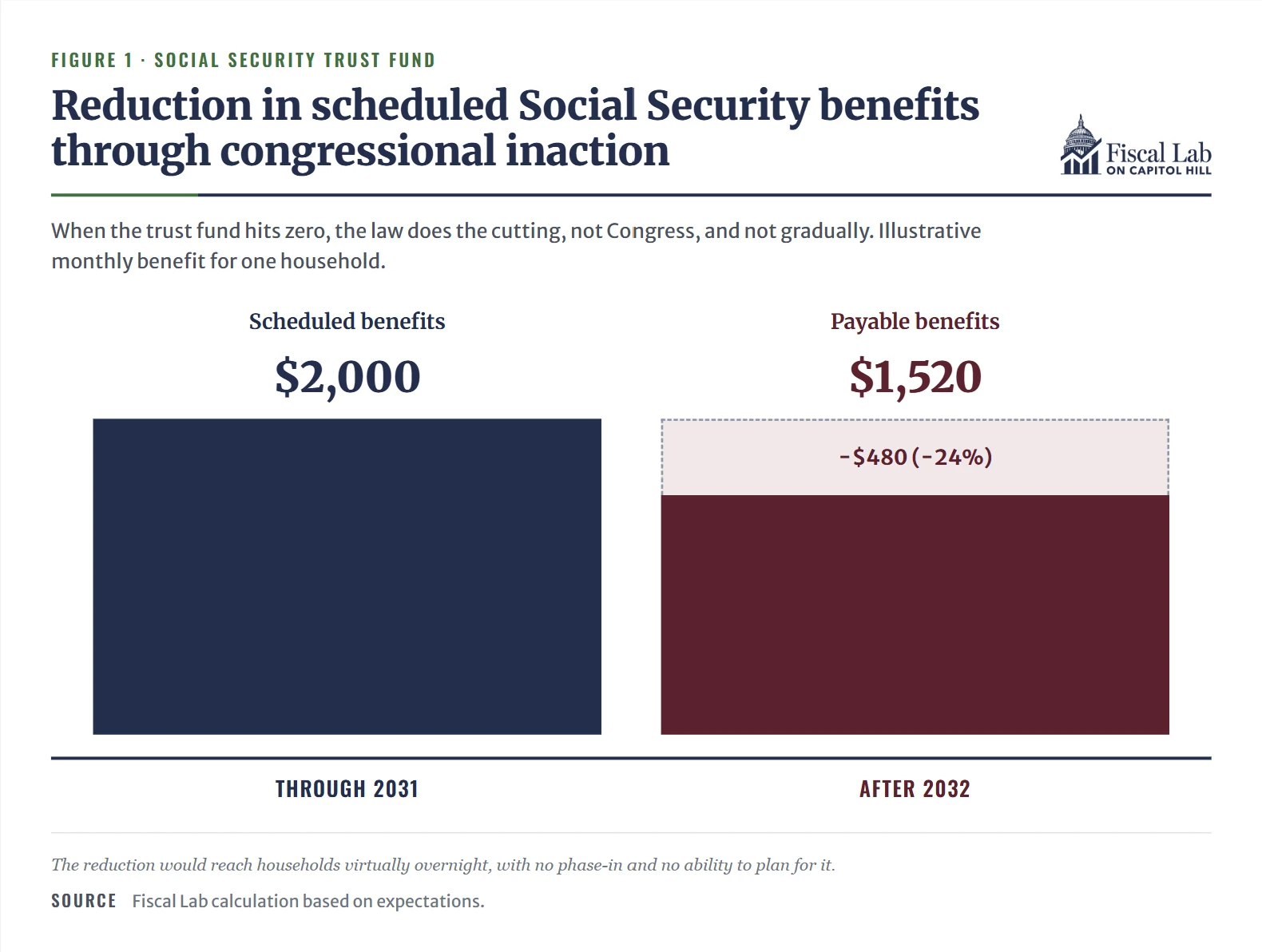
Social Security may be the clearest example of what happens when Washington repeatedly delays difficult fiscal decisions. For decades, commissions, lawmakers, and outside groups have warned that the program’s trust funds are approaching depletion, and a wide range of reforms have been proposed, including changes to retirement ages, benefit formulas, taxable earnings, and means testing. Yet Congress has repeatedly failed to enact a durable solution. Under current projections, a senator elected this November could see the Old-Age and Survivors Insurance trust fund exhausted before the end of that term, in late 2032, triggering an automatic reduction in payable benefits. As shown in Figure 1, a retiree receiving $2,000 per month could see that benefit fall to roughly $1,520, even as the costs of housing, food, healthcare, and other necessities continue to rise. Medicare’s Hospital Insurance trust fund faces similar financing pressure, with depletion projected around 2040.
Washington’s repeated delays and the growing cost of past promises are creating a broader burden for households. Families may be asked to absorb higher prices and borrowing costs, potentially higher taxes, and reduced benefits or public services at the same time. The result is a fiscal squeeze that reaches consumers from both directions: They may have to pay more into the system while receiving less from it.
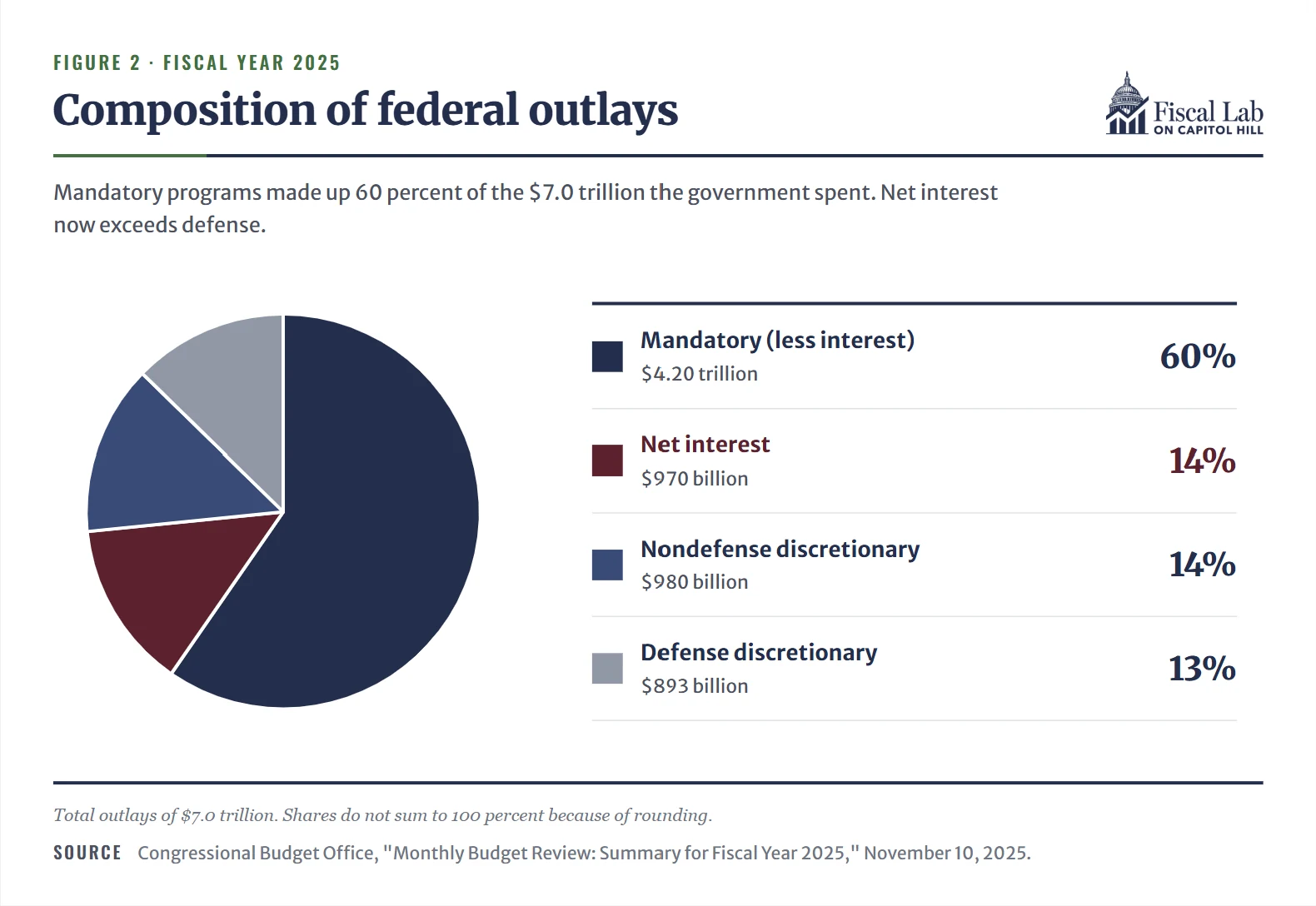
Part of the problem is that Washington’s annual budget fights focus on only a fraction of federal spending. Figure 2 shows federal outlays by category. In FY2025, mandatory programs and net interest accounted for roughly three-quarters of total federal outlays, while discretionary spending, the portion Congress appropriates annually, makes up the remaining quarter. That means many of the highly visible fights over appropriations and government shutdowns are centered on a relatively small share of the budget, while mandatory spending and interest costs continue largely outside the annual appropriations process. Nondefense discretionary spending alone accounts for about 14 percent of total spending and supports priorities including infrastructure, education, research, and other federal services that households and communities rely on.
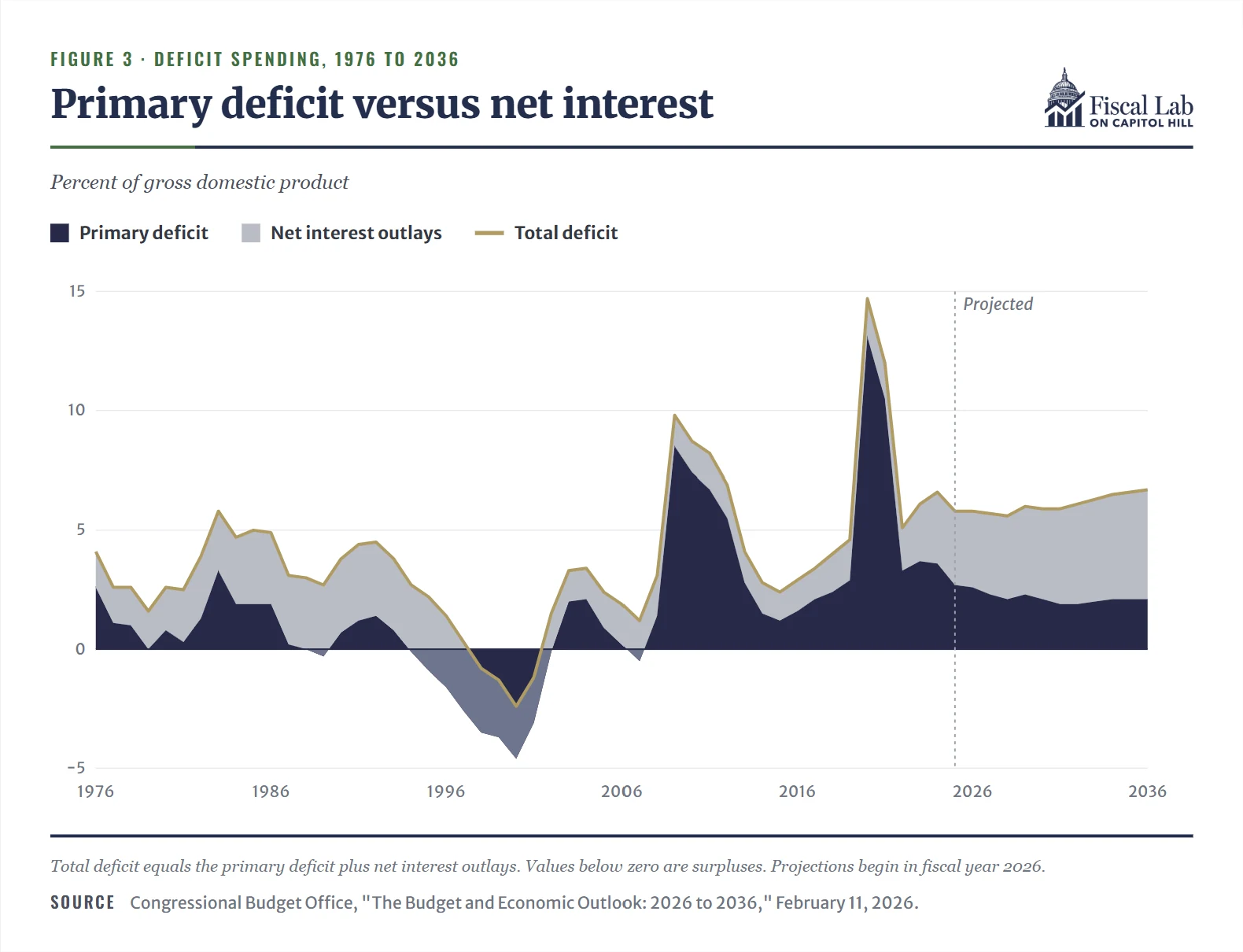
While mandatory spending can still be reformed through congressional action, interest expense is becoming increasingly difficult to control. The primary deficit, the deficit excluding interest costs, is becoming a smaller share of the overall shortfall as the cost of servicing past borrowing grows. At the same time, interest rates have remained above earlier CBO projections, making it more expensive for the federal government to refinance maturing debt and issue new debt. The result is a self-reinforcing cycle: Higher interest costs increase the deficit, larger deficits require additional borrowing, and that borrowing creates still more interest expense. The evidence of this self-reinforcing cycle is evident in Figure 3 as the primary deficit is projected to fall while net interest outlays and the total deficit are projected to rise. Households understand the danger of borrowing simply to keep up with interest payments, and that danger is no different for the federal government.
Washington has been warned about these fiscal challenges for decades, yet policymakers have repeatedly postponed taking action. The problem has not been a lack of proposals, commissions, or opportunities to act, but a repeated unwillingness to accept the near-term political costs of long-term fiscal reform. Instead, difficult choices have been deferred while deficits, debt, and interest costs continued to grow. Each delay narrows the range of available options and increases the risk that future adjustments will be larger, need to happen more quickly, and be more disruptive for households.
The cost of delay is not limited to the federal budget itself. As debt rises and investors are asked to absorb ever-larger amounts of Treasury securities, they may demand higher yields to compensate for greater fiscal and market risk. We are already seeing signs of that pressure today, with higher required yields contributing to elevated borrowing costs across the economy. This matters well beyond Washington because Treasury rates help anchor borrowing costs throughout the economy. A sustained increase in the risk premium on federal debt can therefore feed into higher mortgage rates, business borrowing costs, and other forms of consumer credit. In that sense, deteriorating confidence in Washington’s fiscal path can eventually become another expense on the household balance sheet.
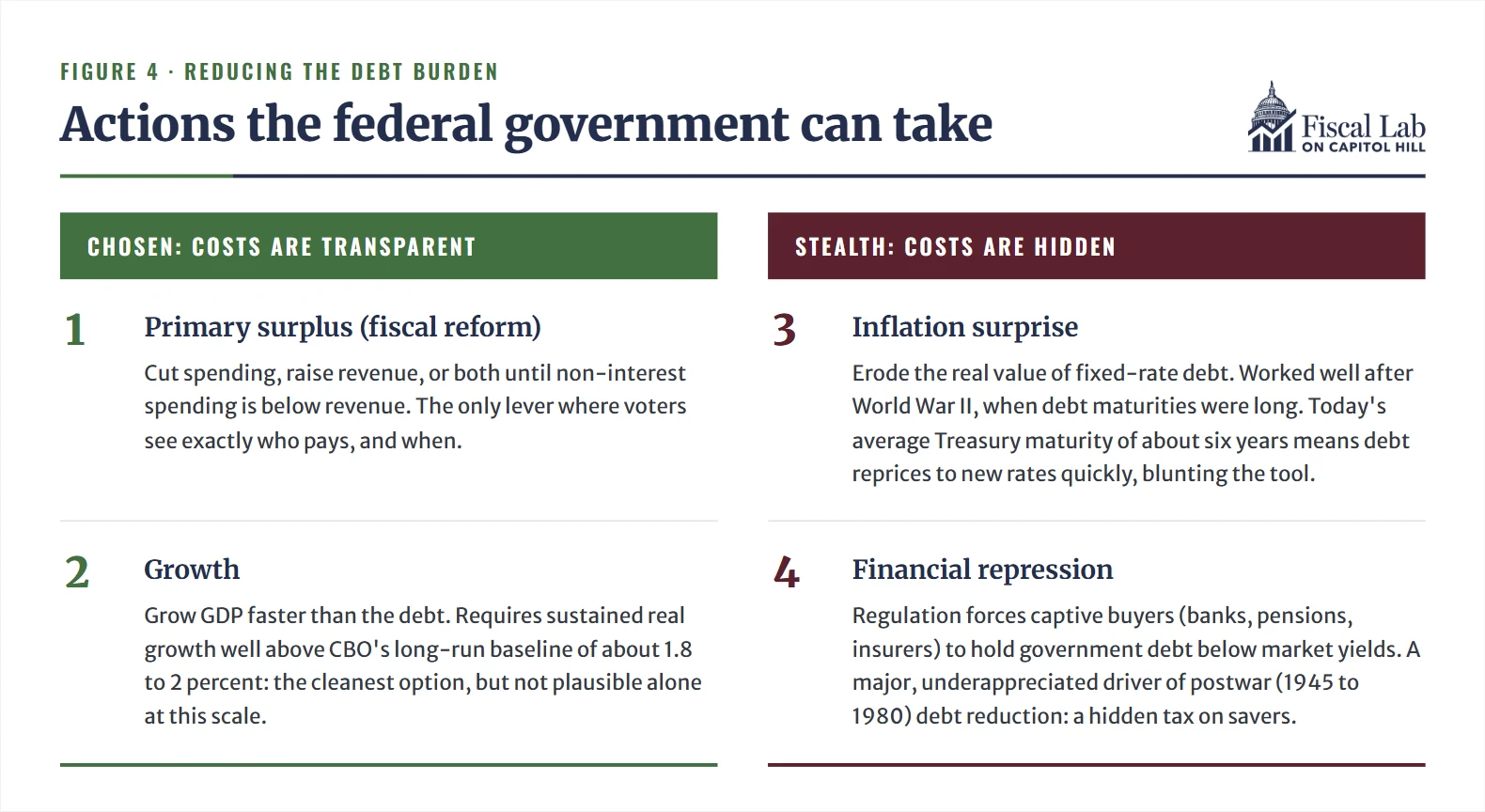
Fiscal reform can come through a relatively small set of options: higher revenues, lower federal spending, faster economic growth, inflation, financial repression, or some combination of these approaches. These options and their impact are shown in Figure 4. Governments have four broad ways to reduce a high debt burden. Primary surplus means directly closing the gap between revenues and noninterest spending through spending reductions, higher revenues, or both. Economic growth reduces the burden by expanding the economy faster than the debt, although growth alone is unlikely to be sufficient if debt continues rising rapidly. The other two approaches shown in Figure 4 are less transparent. Inflation can reduce the real value of outstanding fixed-rate debt, but that benefit is limited when debt must be refinanced frequently at higher interest rates. Financial repression reduces borrowing costs by encouraging or requiring banks, pensions, insurers, or other investors to hold government debt at below-market returns, effectively shifting part of the adjustment onto savers and investors. No option is painless, but each allows policymakers some ability to shape how and when the adjustment occurs.
The option not shown, and potentially the most damaging, is continued delay. Inaction does not eliminate the need for adjustment; it simply increases the likelihood that it will arrive through automatic benefit reductions, crowding out of other federal priorities by interest costs, higher borrowing costs if investor confidence weakens, renewed inflationary pressure, or additional credit-rating pressure during repeated episodes of fiscal brinkmanship. Congress’s inaction will eventually require sharper, more disruptive, and more costly cuts for households.
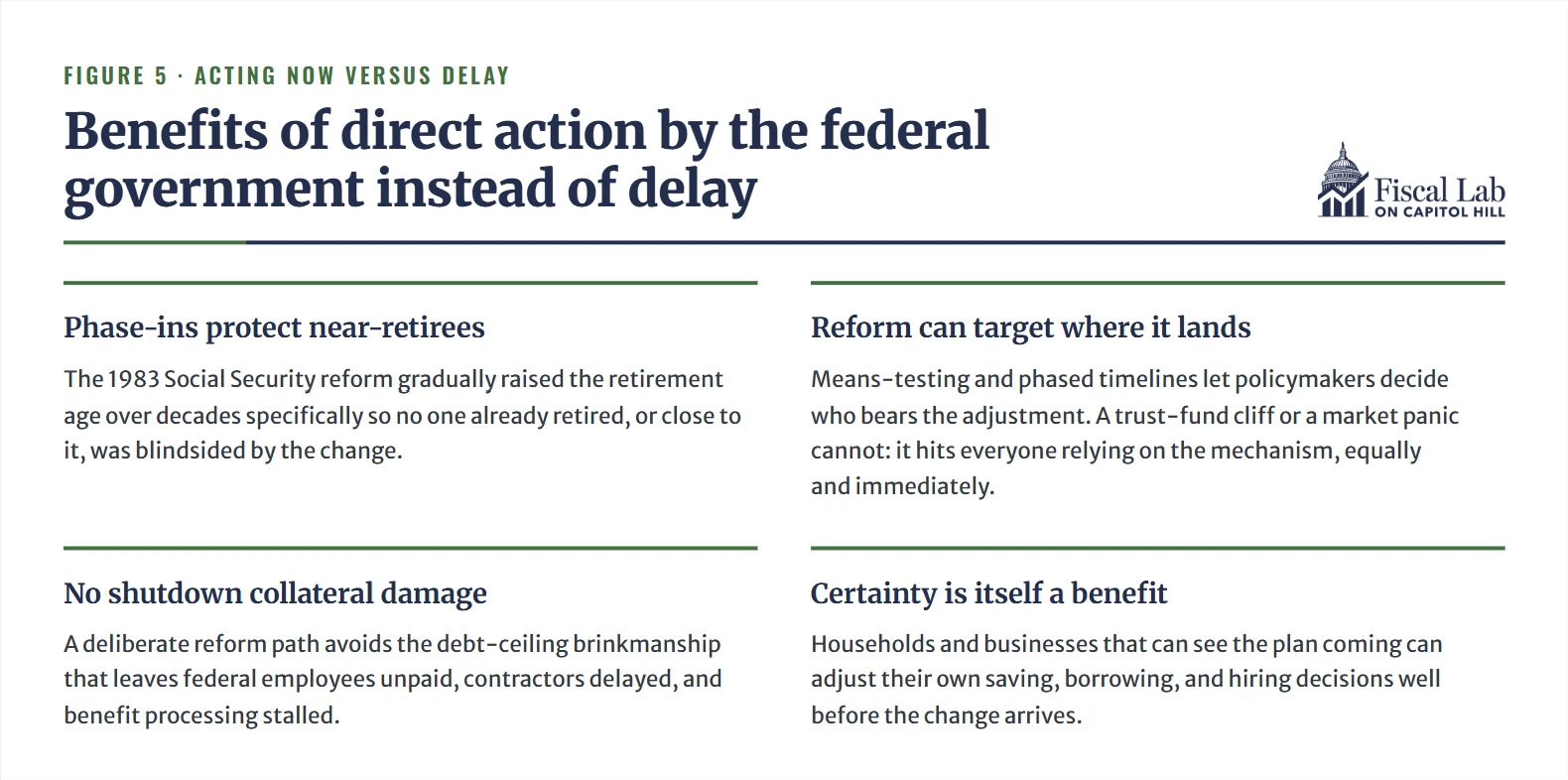
Households will continue to feel pressure if Washington delays action, both through higher costs and through greater uncertainty about future taxes, benefits, and borrowing conditions. Fiscal reform will still require difficult choices, but a deliberate plan allows those choices to be phased in, targeted, and timed in ways that reduce disruption. Figure 5 shows how deliberate actions can allow targeted reform and how policymakers can protect those nearing retirement, shield lower-income households from the sharpest adjustments, and give families and businesses time to adapt. By contrast, when adjustment is forced by trust-fund depletion, market pressure, inflation, or rising interest costs, policymakers have far less control over who bears the burden or how quickly it arrives. The difference is not between pain and no pain; it is between limiting the pain through planning and allowing circumstances to impose it abruptly.
Federal debt can feel distant from household finances, but eventually the two converge. Consumers feel the consequences through mortgage payments, auto loans, inflation, taxes, public services, and retirement benefits. Washington cannot eliminate every cost associated with restoring fiscal sustainability, but it can influence how those costs are distributed and how quickly they arrive.
Washington cannot continue to delay difficult fiscal decisions. It must choose to act responsibly while there is still time to protect those most vulnerable to the adjustment. Policymakers still have the ability to phase in reforms, protect vulnerable households, and give families time to plan. The alternative is to allow economic and fiscal pressures to make those choices for them. Delay does not eliminate the cost. It only increases the risk that the eventual adjustment will be more sudden, more disruptive, and more difficult for American households to absorb.
Joseph McCormack is a senior fellow in economics at the Fiscal Lab on Capitol Hill.