Why Western Democracies, Including the United States, are Experiencing One Fiscal Crisis After Another

Introduction and Background
Fiscal crises in the United States and in many other industrialized Western democracies are occurring with increasing frequency. To avoid future fiscal crises, policymakers would do well to learn the difference between an emergency and a crisis, understand the causes of crises, and identify telltale signs of an impending crisis. In addition, to navigate and survive an unavoidable fiscal crisis, policymakers should educate themselves on how to mitigate the worst outcomes.
Regrettably, the United States is not alone in facing fiscal crises. In addition to the US, many developed economies, from France and the United Kingdom to Italy and Greece, are haunted by their postwar commitments to the general welfare state and the rapidly expanding outlay requirements. The promise to protect vulnerable populations from the insecurities of life may have seemed affordable in the decades following World War II, but undeniably, these outlay commitments now exceed their governments’ revenues and threaten to overwhelm the financial stability of these democracies. As the financial burdens of burgeoning retirement, income, and health security programs grew, these democracies uniformly shied away from serious reforms. Now, these previously affordable commitments threaten the economic future of younger generations and endanger the stability of financial markets, which are key to funding the now-unsustainable government programs.
The decisions not to act significantly on these increasingly expensive programs have spillover effects. Democracies find it difficult and sometimes impossible to fund public infrastructure and national security while simultaneously meeting the mounting needs of means-tested welfare programs and public entitlements. When the spending constraints begin to undermine these important functions of government, Western democracies turn more frequently to deficit spending and the markets for government debt. While the US publicly held debt-to-GDP ratio is 98%, most of Europe fares worse: In France it is 111%, in Italy it is 135%, and in Greece it is 154%. Deficit spending has become the norm, leading to growing interest payments that now increasingly dominate these democracies’ central government spending.
These features of our postwar fiscal history create one fiscal crisis after another. Sometimes it comes in the form of parliamentary sclerosis as ministerial governments collapse after failing to convince the electorate of the need to change. Such was recently the fate of two French governments that failed in just the past year.[1] At other times, a crisis erupts when credit rating agencies downgrade sovereign debt, or bankers sell their government bonds, or overspending produces ruinous inflation.
What Is a Crisis?
Policymakers need to understand the difference between fiscal crises and emergencies. An emergency, like a hurricane or fire - where emergency response and aid are sent to help those in need - may contribute to crises, but an emergency is not necessarily a crisis. Crises emerge when a compounding, long-term threat prevents a nation from fulfilling its obligations. An emergency is your car needing repairs. A crisis is when you must choose between buying groceries or repairing your car so you can continue to get to work - or worse, when your credit card is maxed out and you’re unable to afford either. This is the type of crisis toward which the US is heading, and where further delays in addressing this problem reduce the ability of policymakers to act.
The United States and our democratic allies are all on similar glidepaths toward fiscal crises, and we may be approaching a tipping point - one in which the United States cannot respond to either short-term emergencies or fulfill its long-term obligations and commitments to provide basic services.
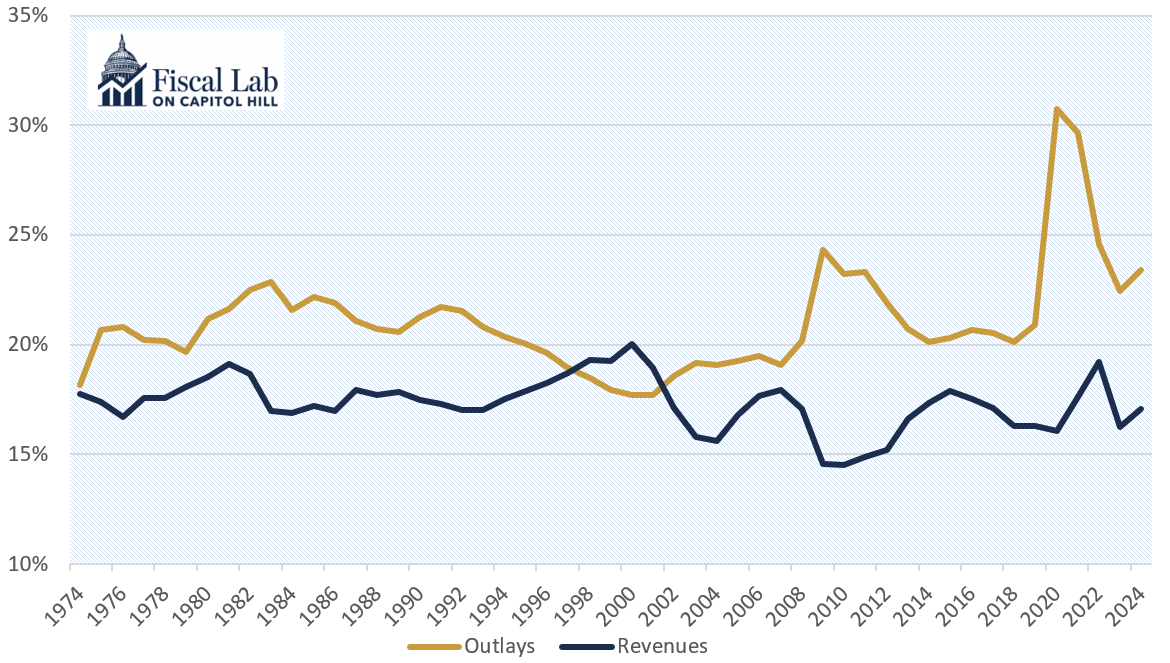
Policymakers need to consider the reality of the situation. The United States has collected revenues equal to 17.3% of GDP, on average since 1974, while spending during this same period has averaged 21.1% of GDP. The peak revenue collected was 20% of GDP in 2000, while spending peaked at 30.7% of GDP in 2020, due to the COVID emergency. Hence, maximum revenue collected as a percent of GDP over the last 50 years has never equaled the average spending level, and the maximum spending level exceeded the highest revenue by over 10 percentage points (Figure 1).
However, there are limits to how much revenue the government can collect in taxes. Higher taxes may reduce a country’s economic output, and therefore, the government’s spend rate must adjust to the realities of its revenue collection. As it is, the United States has a spending problem. This is not a new point, but we must understand it, as there is mounting evidence that we may cross the threshold into uncharted fiscal crisis territory where the government may fail to be able to afford basic services.
Figure 1. Government revenues and outlays as a percent of GDP
Citation: Budget and Economic Data | Congressional Budget Office
Currently, mandatory spending - that is, spending tied to eligibility criteria and required by law (such as Social Security, Medicare/Medicaid, and other entitlement programs), plus the interest we pay o n existing debt - exceeds total revenue collected in 2024. This remains the case in 2025. That means, every cent spent on defense, transportation, education, housing assistance, disaster relief, and other discretionary programs must be borrowed. Meanwhile, total US debt (publicly held plus interagency debt) remains above 100% of GDP. In the early 1980s, this figure was just above 30%. Excluding a brief four-year span at the turn of the century, the consistent deficits over the last 50+ years have caused our debt to grow significantly.
Policymakers need to grapple with the fact that our total federal debt now exceeds the output of our economy. GDP is defined as the final value of all goods and services produced by the United States in a year. Today, the value of everything produced in a single year does not equal the amount the US has borrowed and currently owes. Some might observe that many home mortgage loans exceed the borrower’s yearly income. This works over time, provided that the borrower’s income exceeds expenses, allowing most borrowers to pay down their mortgages and reduce their balances. However, the United States is still borrowing each year, with spending exceeding revenue collection. In 2024, the deficit was over 6% of GDP, forcing the government to borrow more and more, while the total debt continued to grow. This is a recipe for fiscal crisis, and our creditors, who finance our spending, are starting to take notice. Indeed, the rolling annual average of total deficits since August of 2024 now stands at $1.9 trillion.[2]
People with poor credit are considered subprime borrowers in the United States and they often face higher interest rates due to the greater risk involved in lending to them. This is no reflection on their worth as individuals and members of society; it is just that lenders are not charities. They must rationally charge a higher premium to cover their losses from those who might not be able to eventually pay back what they borrowed. It is critical that policymakers take stock and recognize that the United States government may be entering into such territory.
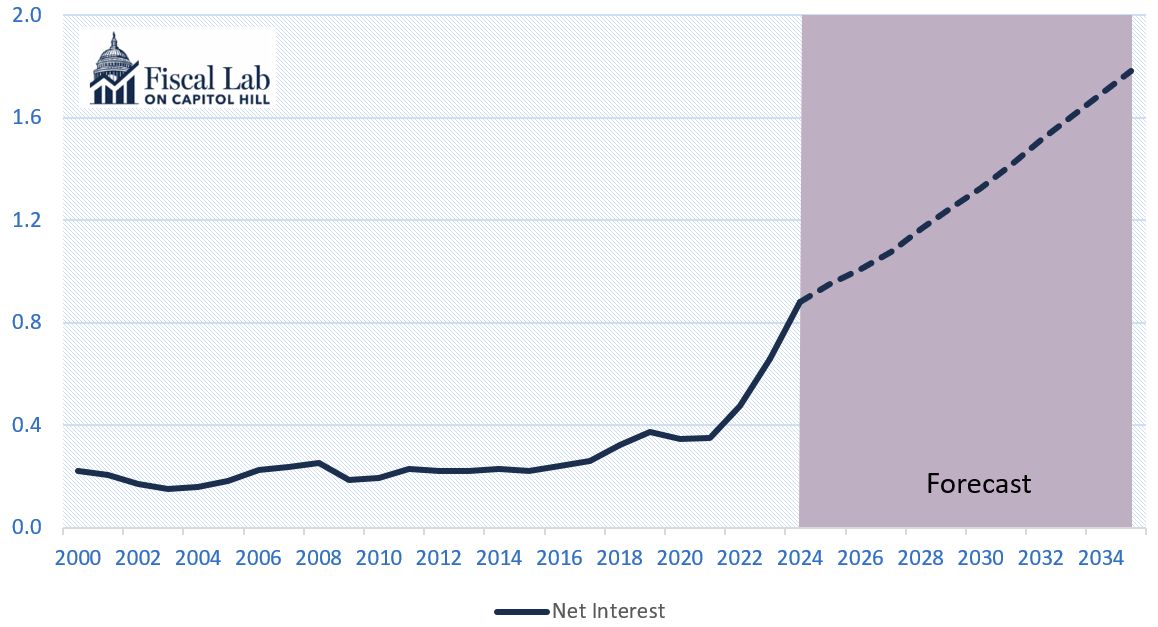
In May 2025, Moody’s became the last major credit agency to downgrade the federal government’s credit rating. Standard & Poor’s downgraded US debt in August 2011, following a debt ceiling legislative standoff, thereby raising the risk of default. Fitch Ratings followed suit in August 2023, citing rising debt and a lack of government cohesion. These downgrades mean that it costs more for the government to borrow - and will continue to cost more - as the United States continues to borrow. In 2024 alone, $881 billion was spent on interest payments - money that produced no schools, no bridges, no medical breakthroughs. From 2000 to 2020 the average interest payment was $232 billion. By 2035 this figure is projected by the Congressional Budget Office (CBO) to rise to $1.78 trillion (Figure 2).
Figure 2. Government net interest - trillions of US dollars
Citation: Budget and Economic Data | Congressional Budget Office
None of this happens in a vacuum. Policymakers need to understand that their spending and overspending decisions push up long-term interest rates. This, in turn, affects borrowing costs like 30-year mortgages rates, making it more expensive for Americans to buy a home. In financing the debt, the US Treasury has increasingly relied on short-term bonds, which often cost more in interest during a period of rising interest rates, because they must be refinanced more frequently and are more vulnerable to interest rate growth. As interest rates have increased in the last few years, the cost of financing existing and additional debt has also gone up. This strategy has led to weak or “failed” Treasury auctions, where the US struggles to find enough buyers for its debt without offering higher interest rates, to account for the greater risk term premium of the growing debt, both on newer debt and the rollover of older debt. One such instance occurred in May 2025, when “the market” (financial centers like Wall Street) took notice, leading to a stock and US dollar sell-off.
Currently, governments around the world hold US dollars as a reserve currency due to its perceived stability - much like individuals might hold gold or other precious metals. One current estimate of these foreign holdings is just north of $9 trillion, mostly in bonds.[3] But the value of these reserves is weakening as inflation and political instability reduce the strength and reliability of the US dollar. If countries begin to sell off their US dollar-denominated reserves, it could further weaken the dollar and worsen inflation, especially for imported goods.
Inflation also plays a role in deepening the adverse effects of fiscal crisis. To finance some of its spending, the US government supplements its tax revenue by increasing the money supply (i.e., it prints more money). However, when the amount of money and credit grows beyond the market’s demand for liquidity, the dollar’s value falls. That is why a rare Honus Wagner baseball card is worth a fortune, while a mass-produced Derek Jeter rookie card - though meaningful to fans - has little monetary value. When the government expands the money supply to provide more funds for its programs, it risks major inflation, which further weakens American consumers’ spending power - many of whom are already struggling.
The US spends more than it collects, its national debt exceeds its annual economic output, and the federal government continues to borrow at unsustainable levels - with little sign of change. The 10-year CBO projection suggests outlays will exceed revenues by more than 5% of GDP annually. Policymakers need to grasp that this is a perfect storm for a major financial crisis. The elements are there; all that is lacking is the spark to set it off.
Conclusion
Several key factors make this a true crisis, rather than just an emergency:
- First, seniors who rely on Social Security could see major benefit cuts as the government tries to keep the program solvent, making it harder for them to afford housing and food, especially as inflation continues to erode purchasing power.
- Second, we may see worsening transportation infrastructure, as the US struggles to finance bridge and road repairs. Our aging infrastructure may eventually fail, disrupting supply chains and daily life.
- Third, our military readiness could suffer. If the US depends on foreign creditors - like China, one of our largest debt holders - what happens if they dump our debt because they oppose a US military action? Policymakers should not assume that the US can rely on other nations’ approval to fund our national defense.
While political polarization continues to deepen, one simple fact remains: If policymakers fail to work together to reduce the annual deficits and pay down the publicly held debt, the legacy that will be left will require future draconian budget reforms that will impoverish all Americans.
That, by any reasonable definition, is a crisis.
Notes
- John Leicester, “French Government Collapses in a Confidence Vote, Forcing Macron to Seek Yet Another Prime Minister,” Associated Press, September 8, 2025, https://apnews.com/article/france-macron-bayrou-budget-d60c7c0881f3c8d633f02653043c1f55. ↩
- Committee for a Responsible Federal Budget, “12-Month Rolling Deficit is $1.9 Trillion in August 2025,” September 9, 2025, https://www.crfb.org/blogs/12-month-rolling-deficit-19-trillion-august-2025. ↩
- Treasury Bulletin (US Treasury, Bureau of the Fiscal Service, September 2025), Table OFS-2 “Estimated Ownership of U.S. Treasury Securities,” https://www.fiscal.treasury.gov/reports-statements/treasury-bulletin/current.html. ↩