Young Americans Are Struggling to Buy Homes


Executive Summary
Homeownership has always been considered the cornerstone of the American dream. However, in recent years, that core American ideal has become increasingly out of reach for younger Americans. Rising everyday costs and financial burdens have forced many Americans to forgo buying a home until much later in life. This, in turn, often postpones other key milestones for many, such as marriage and raising children. This delay in purchasing a home can cause many to also miss out on building home equity. Finally, the impact of these delays can create generational challenges for decades to come. However, fixing the issue of delayed homeownership is far from simple given the numerous pressures that drive it.
Introduction
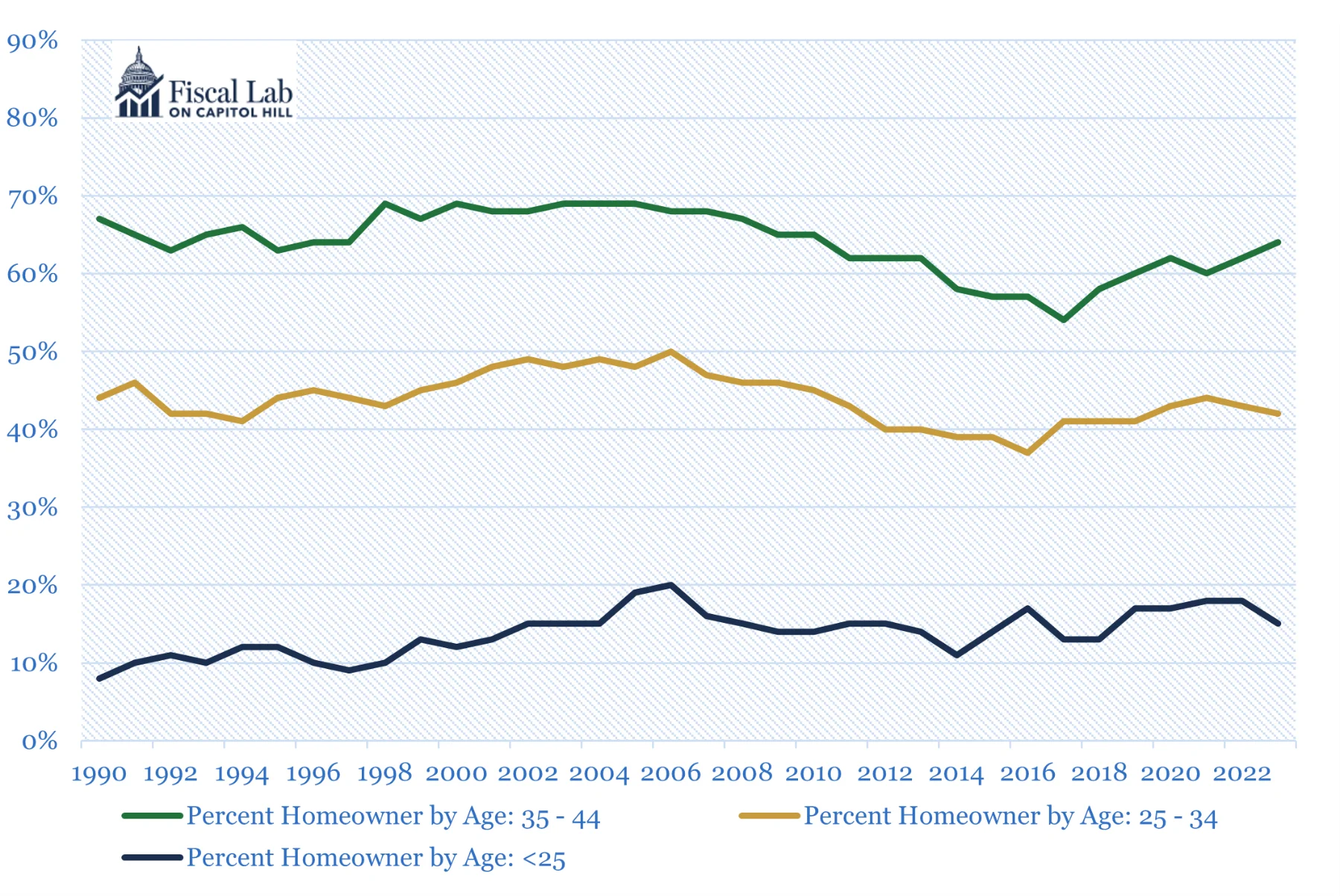
In 2006, homeownership among those 24 years old or younger peaked at 19 to 20 percent, with roughly half of all 25- to 34-year-olds owning a home. By 2023, those numbers had fallen to 15 percent and 42 percent respectively. Ultimately, younger Americans who are trying to become homeowners are the most affected. Despite the argument that wages have not kept up with inflation historically, the cost of homes has outpaced other measures of inflation and wages, turning affordable “starter homes” into something else entirely. In fact, just in the last few years, the rate of homeownership for those under 24 fell from 18 percent to 15 percent. Meanwhile, ownership among those aged 35 - 44, which hit a low of 54 percent in 2017, climbed to 64 percent in 2023 (Figure 1). Overall, younger Americans are increasingly struggling to purchase a home, waiting longer and longer before buying.
This report has two goals; the first is to examine the fiscal pressures that younger Americans who aspire to homeownership are facing and the second is to highlight federal policy that exacerbates the declining rate of homeownership among younger Americans. I also discuss proposed reforms that may help alleviate the problem. The government must reign in wasteful spending to lower inflationary pressures, reduce restrictions that make homes more difficult to build, and provide government programs that could benefit younger first-time homeowners.
Historically, Americans would build assets early to allow for economic mobility. Homeownership has been a foundation of building wealth, economic mobility, and has allowed for transferring of that equity resulting in intergenerational wealth. Those who own a home typically have a higher net worth than renters, and this wealth can be persistent across generations. Lower-income Americans have historically built wealth through homeownership. This is partially because equity in a home is less liquid or flexible than other financial assets, and because home equity is built through regular payments. Further, parental homeownership leads to not only greater wealth of the homeowner but, in the past, their children as well.[1] Unfortunately, younger Americans today are not building assets and are instead waiting for intergenerational transfers from their parents. This delay in building assets may cause a persistent decline in their quality of life, reduce their lifetime wealth, and potentially the quality-of-life and lifetime wealth of their children. Through this paper you will see why younger Americans today are struggling to buy homes, despite whether their parents owned homes or not.
Figure 1. Percent homeowner by age bracket
Citation: Consumer Unit Characteristics: Percent Homeowner by Age: < 25 | FRED | St. Louis Fed
Consumer Unit Characteristics: Percent Homeowner by Age: 25 - 34 | FRED | St. Louis Fed
Consumer Unit Characteristics: Percent Homeowner by Age: 35 - 44 | FRED | St. Louis Fed
As mentioned, a growing barrier to homeownership is cost. Rising home values are driven not only by increasing land values and construction expenses, but also by restrictive building regulations and zoning.[2] These cost barriers join other financial challenges shouldered by younger households: growing debts primarily from student loans and borrowing to pay for basic necessities, like rent. These cost challenges clearly reduce their ability to save for a down payment.
[caption id="attachment_868" align="alignright" width="278"]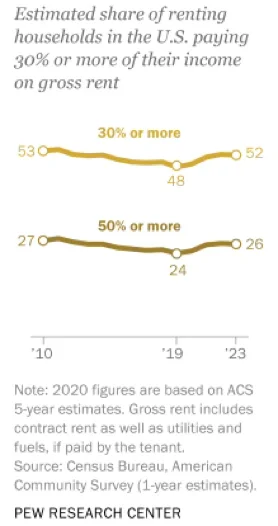 Figure 2. Housing affordability. Citation: The State of Affordable Housing in the US | Pew Research Center.[/caption]
Rising expenses from higher inflation has eroded the ability of many Americans to save, a necessary first requirement for homeownership if a down payment is required. Rising rent has become a larger burden and prevents savings. The Department of Housing and Urban Development (HUD) defines “affordable housing” as spending no more than 30 percent of gross income on housing costs, including utilities. Yet a 2023 Pew Research Center study found that most Americans spend above that threshold, with more than a quarter devoting over 50 percent of their income to housing (Figure 2). Rising costs extend beyond housing: The Consumer Price Index has risen by a cumulative 27.5 percent since January 2019, meaning grocery bills, utilities, and other essentials are nearly 30 percent higher than just five years ago. Median household income in the United States has not kept up with inflation, only rising 20 percent during this same time period. This disparity between the growth of prices and income has left homeowners with lower real purchasing power. These rising costs, and inability for incomes to keep up, are persistent hurdles to homeownership. Dr. William Beach and Dr. Paul Winfree address this in their article, “The Family Budget Crunch: Prices Outpace Earnings.” They point to average weekly earnings, which have fallen behind the overall rate of inflation, creating a “‘silent depression’ - meaning, it is harder to buy the ingredients of the American Dream today.”[3] The gap that grows between average prices and earnings further “crunches” families and restricts their future growth.
As rents and expenses have increased for many Americans, the price of a home has grown significantly as well, which has made down payments (usually a percentage of the purchase price) far more daunting. Since 2019, the median home price has risen 31.2 percent. In 2019, the median home cost was about $320,000; today it exceeds $410,000, requiring an additional $18,000 for a 20 percent down payment. Beyond higher prices, interest rates have surged since the pandemic. The 30-year mortgage rate had dropped below 4 percent by 2019, and during COVID many homeowners refinanced at under 3 percent. Today, mortgage rates exceed 6.5 percent. On a $400,000 home with 20 percent down, this translates into nearly $675 more per month compared to pre-pandemic rates - requiring about $8,000 per year more in after-tax income just to afford the same house. Homebuyers are being squeezed from every direction.
Taxes and the price of insuring homes has also significantly increased and becomes an added monthly cost on top of the principal payment and interest expense. These costs can vary significantly across the US, as states and cities can have high property taxes, further eroding the income of younger Americans and affecting their ability to make their monthly payments. Illinois has some of the highest property taxes in the country, but if you lived in Aurora, IL the city property taxes would require you to pay even more. This is entirely dependent upon how states and cities structure their tax revenue mix and their reliance upon property taxes. Beyond taxes, insuring a home can also be significantly expensive depending upon severe weather in the region. While Florida has higher costs because of hurricane risks, many homeowner insurance costs in the middle of the country are expensive due to tornadoes and wildfires. This growing cost further creates a barrier to entry with such a high monthly expense.
Economic uncertainty adds another layer of difficulty for homeowners. A recent Redfin poll found that two in five workers are delaying or canceling major purchases, a figure that rises to over half among households earning less than $50,000 (compared to a 2023 median household income of $80,610). Even among those earning $100,000 or more, one-third are holding back on large purchases. Job security fears play a role: About one-third of workers report being somewhat or very concerned about their employment stability. This caution reduces consumer spending, slowing GDP growth.[4] In housing specifically, sellers currently outnumber buyers by over 500,000 (34 percent more sellers than buyers as of May 2025, per Redfin).[5] Despite this “buyer’s market,” existing home sales flattened in June and July, with high interest rates, inflated values, and steep down payments keeping buyers on the sidelines. Unless affordability improves, further price declines remain possible.
An additional issue that impacts housing affordability are policies set by federal, state, and local governments on restrictive zoning and building practices. Overly restrictive policies and “not in my backyard” (NIMBY) attitudes can consistently prevent new properties from going up that could help eliminate the strain on the housing shortages. These policies can include requirements on the number of parking spots, restrictions on lot size, allowing residential property in commercial zones, and blocking zoning changes that make existing conditions illegal. Currently, many new constructions may require a minimum number of parking spaces that may not be necessary in downtown areas with public transit. Lot size requirements can restrict new homes from going up on smaller pieces of property or restrict how many homes can be built in a particular area. Commercial areas could serve dual purposes by allowing commercial use on lower levels and residential properties on upper levels. Finally, often times planning commissions/boards will rezone regions that make it harder to build additional properties that match the existing property types. All these zoning regulations create significant roadblocks for developers trying to build new properties. Additionally, aesthetic mandates and building requirements limit how many apartments can be built in a given space. By updating zoning and construction standards that allow for more effective opportunities to build cost-effective housing, policymakers can reduce the burden on many Americans.
Government-Driven Costs
From the information above, it is clear to see the significant hurdles many younger Americans face when trying to buy a home. They are facing financial burdens from carrying debt, rising costs from rent, groceries, and everyday expenses, ballooning home prices that far outpace inflation and wages in terms of growth, and restrictive government policies that limit the ability for new homes to be built, which could ease some of the supply constraints. Although the problem can be defined simply as falling homeownership for younger Americans, the cause is much more complex. Falling homeownership has been exacerbated by numerous government policies beyond zoning and building restrictions. Federal policy and actions further restrict home affordability.
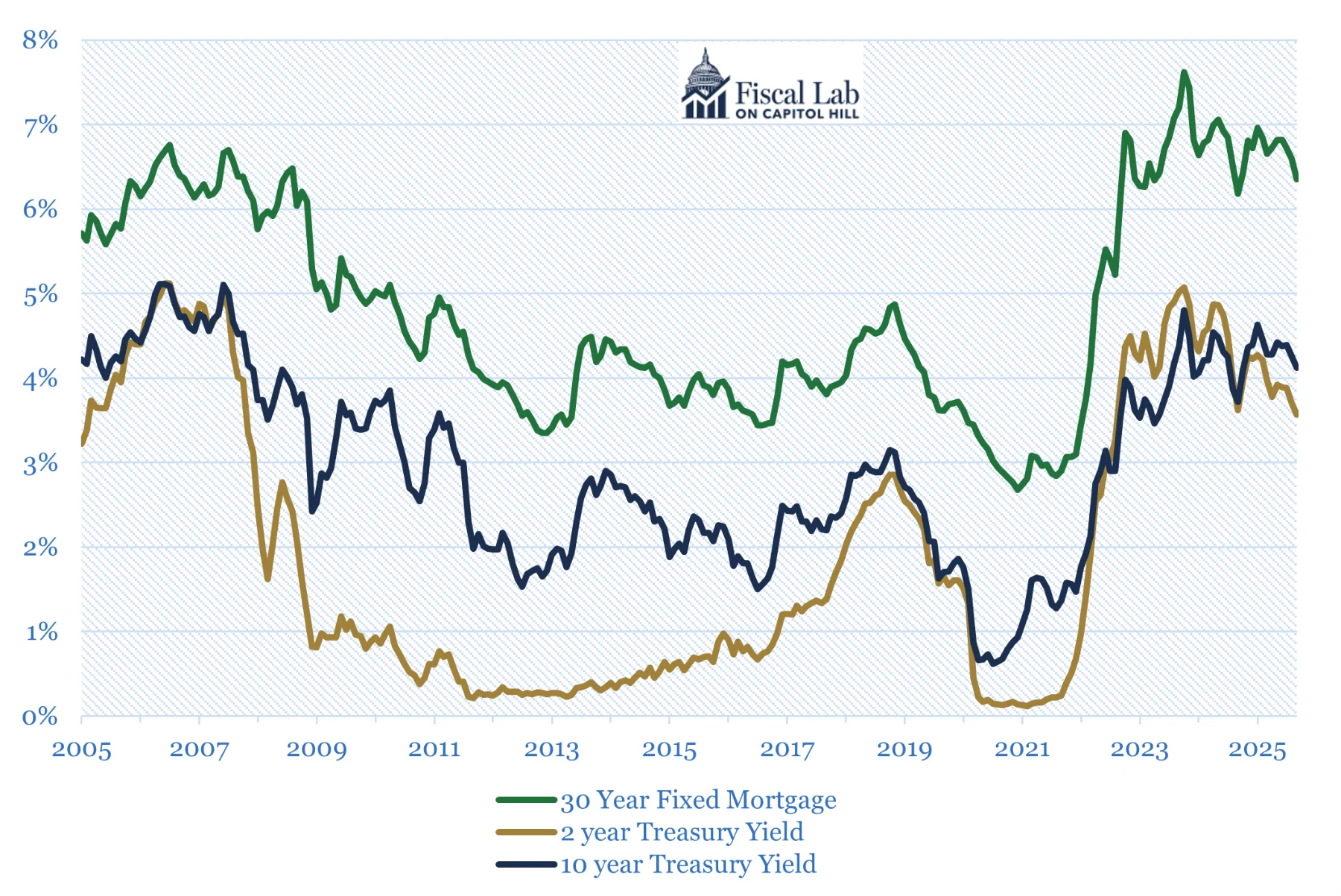
A key problem of recent government behavior is deficit spending. Deficit spending forces the government to continually borrow money to finance new debt and refinance existing debt. As the government borrows more, it must offer higher yields on Treasury securities, which in turn pushes up mortgage rates. Over the past 20 years, 30-year mortgage rates have correlated strongly with 10-year and two-year Treasury yields (correlation levels of 94.7 percent and 88.0 percent respectively).[6] Following COVID, as Treasury yields climbed, mortgage rates surged alongside them - further raising the cost of homeownership (Figure 3). Even as the Federal Reserve has taken actions to lower their target rate, the corresponding longer-term yields have not come down in the same manner, causing the cost of borrowing to remain high.
Rising deficits also crowd out discretionary spending, reducing funding for programs such as affordable housing initiatives. As the government continues to fail at reforming entitlement spending, which are the principal drivers of deficits, the federal budget will continue to be subject to persistent deficits. In 2024, mandatory programs (Social Security, Medicare/Medicaid, and other entitlements) plus net interest payments exceeded all federal revenue, meaning every discretionary dollar had to be financed through debt. This squeezes housing support programs, like HUD’s public housing, housing vouchers, and low-income housing tax credits. The government’s failure to address rising costs of entitlement spending causes many younger Americans to believe they will never see Social Security benefits, despite paying into the system. These funds, taken from their paychecks, further erode their ability to save.
Figure 3. 30-year mortgage rate to 2- and 10-year Treasury yields
Citation: 30-Year Fixed Rate Mortgage Average in the United States | FRED | St. Louis Fed
Market Yield on U.S. Treasury Securities at 10-Year Constant Maturity | FRED | St. Louis Fed
Market Yield on U.S. Treasury Securities at 2-Year Constant Maturity | FRED | St. Louis Fed
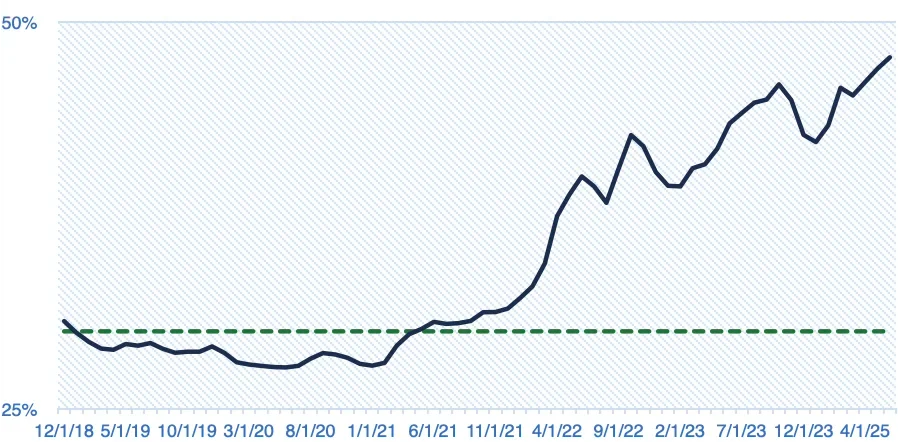
2019 through 2023, wages lagged inflation by about 5 percentage points, leaving households worse off. By Q4 2023, the median home price had risen 35.2 percent. As Parker Sheppard will address in his fiscal dominance article, a pending publication, government spending, when not linked to future taxes, will drive up inflation. As inflation raises the price of goods and services, it also lowers the real value of the deficit and debt (and all other goods and services) until the deficit and debt reach a sustainable level. This inflation causes the value of the dollar to fall and therefore raises the price of goods and services. This inflation also impacts home and rental costs. The Atlanta Fed’s Home Ownership Affordability Monitor, which measures the share of median income required for a mortgage on the median-priced home, rose from 30 percent in 2019 (aligned with HUD’s affordability definition) to 48 percent today (Figure 4). For many, homeownership is now simply out of reach.[7]
Figure 4. Atlanta FED Home Ownership Affordability Monitor
Citation: Home Ownership Affordability Monitor - Federal Reserve Bank of Atlanta
Interestingly, if future homeowners measured affordability in terms of gold rather than wages, the picture would look different. Since January 2019, gold prices have more than doubled, meaning it takes fewer ounces of gold to purchase a home today than it did five years ago. This highlights how the dollar’s value has steadily weakened, while hard assets like gold have retained (or even increased) purchasing power.[8] The federal government’s persistent spending and failure to control deficits have eroded the dollar’s strength, driven up prices, and further undermined affordability for households trying to save.
What Congress Can Do
Persistent federal deficits are raising borrowing costs and driving up inflation. Absent true reform by the federal government, Americans will continue to see deficits drive up borrowing costs, inflation, and the reduction of housing assistance programs, limiting their ability to own homes. Congress can take three steps to help make homes more affordable.
First, the government must rein in spending to reduce deficits that fuel higher interest rates and inflation. By restraining spending and borrowing less, or generating a surplus, Congress would encourage a significant reduction in borrowing, which, in turn, would mean less borrowing by the US Treasury, thus allowing interest rates to fall. As noted, the 30-year mortgage rate tracks closely with Treasury yields, and when the federal government lowers its rate of borrowing it will simultaneously reduce the cost of borrowing for future homeowners. Restraining government spending will also help to reduce persistent inflation which impacts many who are trying to save for a home. A reduction in government spending will reduce some crowding out effects that drive up prices. By addressing wasteful spending, the government may instead focus on programs that could benefit future homeowners.
Second, beyond reining in government spending to limit inflation and higher interest rates, there are some government programs that cost money that significantly benefit homeowners. The mortgage interest deduction lowers the cost of owning a home. Additionally, when selling a home there is a capital gains exclusion on the income received that allows for continued upward mobility of buying a future home. These tax incentive programs may reduce income received by the federal government, but they also lower the financial burden of owning a home, thereby benefitting many Americans.
Finally, as outlined above, restrictive regulations limit housing supply. While many of these are state-driven or local in nature, federal policymakers could establish a task force to identify effective reforms and promote them nationally. Potential changes include removing parking mandates, reforming zoning laws to allow mixed residential use in commercial zones, preventing exclusionary zoning practices, and permitting HUD-code homes to be built on residential lots without redundant inspections. Such reforms could meaningfully increase supply and improve affordability. The federal government could come out with clear guidelines and policies that states can use to improve housing affordability and access. HUD already provides block grants and other programs to help housing affordability.[9] However, state and local regulations may be overly restrictive. A recent 2023 program by HUD, Pathways to Removing Obstacles to Housing (PRO Housing), has begun to address these problems, targeting specific cities. However, absent significant expansion of this program, the results will remain limited and fail to help a majority of Americans.
Homeownership is paramount to economic mobility, intergenerational wealth, and is the cornerstone of the American dream. Ensuring Americans own their own homes helps lift many out of poverty, increasing their net worth and offering upward economic mobility for their children. Congress can act, and help make this dream sustainable for many Americans, by pursuing reforms that benefit future homeowners. Actions taken by federal legislatures, in coordination with state and local policies, can help restore homeownership, which is currently out of reach for so many younger Americans, as the first step toward achieving the American dream.
Notes
- Stuart M. Butler, William W. Beach, and Paul L. Winfree, Pathways to Economic Mobility: Key Indicators (The Pew Charitable Trust, 2008). ↩
- Restrictive land-use rules - like large minimum lot sizes, height limits, parking minimums, zoning restrictions, and lengthy discretionary approvals - reduce buildable density, add compliance costs, and slow project timelines, making new homes harder and more expensive to build. ↩
- William W. Beach and Paul Winfree, “The Family Budget Crunch: Prices Outpace Earnings,” Economic Policy Innovation Center, January 22, 2024. ↩
- Mark Worley, “Two in Five American Workers Are Delaying or Canceling a Major Purchase Like a Home or Car Due to Feelings About Job Security,” Redfin, August 21, 2025. ↩
- Lily Katz and Asad Khan, “The US Housing Market Has Nearly 500,000 More Sellers Than Buyers - The Most on Record. That Will Likely Cause Home Prices to Fall,” Redfin, May 29, 2025. ↩
- Andrew Lautz, Francis Torres, and Caleb Quakenbush, “Why the National Debt Matters for Housing,” Bipartisan Policy Center, September 26, 2024. ↩
- Federal Reserve Bank of Atlanta, “Home Ownership Affordability Monitor,” accessed September 9, 2025. ↩
- MacroTrends, “Gold Prices - 100-Year Historical Chart,” accessed September 9, 2025. ↩
- Emily Hamilton, Salim Furth, and Charles Gardner, “Housing Reform in the States: A Menu of Options for 2024,” Mercatus Center at George Mason University, August 23, 2023. ↩