Interest Rates Rising Above CBO Projections
Interest rates are running above the Congressional Budget Office’s (CBO) projections from the most recent baseline. These higher interest rates could have significant effects on the budget.
Actual Interest Rates vs. CBO’s Projections
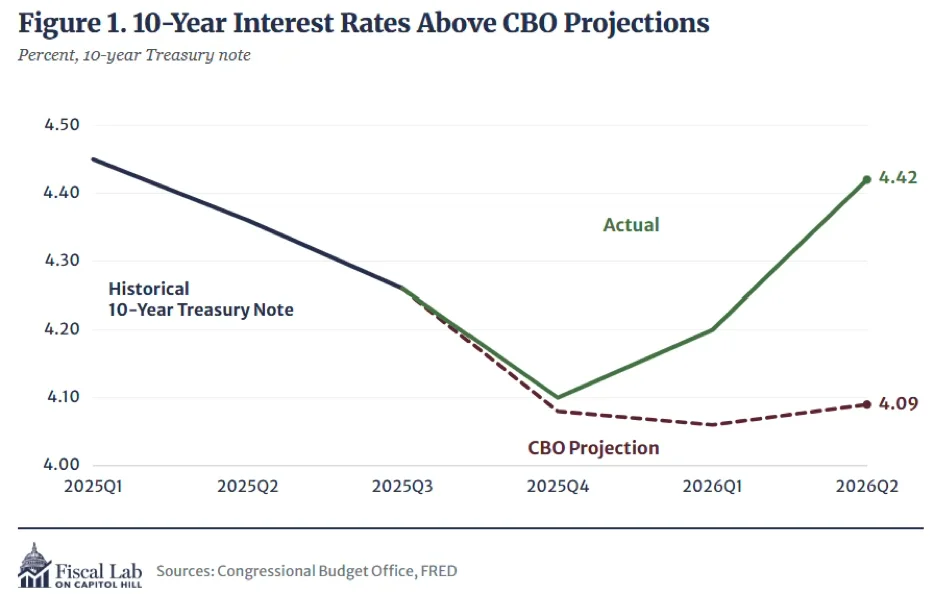
In its February 2026 baseline, the CBO projected that the interest rate on 10-year Treasury notes would average 4.06 percent in the first quarter of 2026 and 4.09 percent in the second quarter.[1]
The actual interest rate was 4.20 percent in the first quarter (14 basis points higher than the CBO’s baseline) and 4.42 percent in the second quarter (33 basis points higher than the baseline).[2]
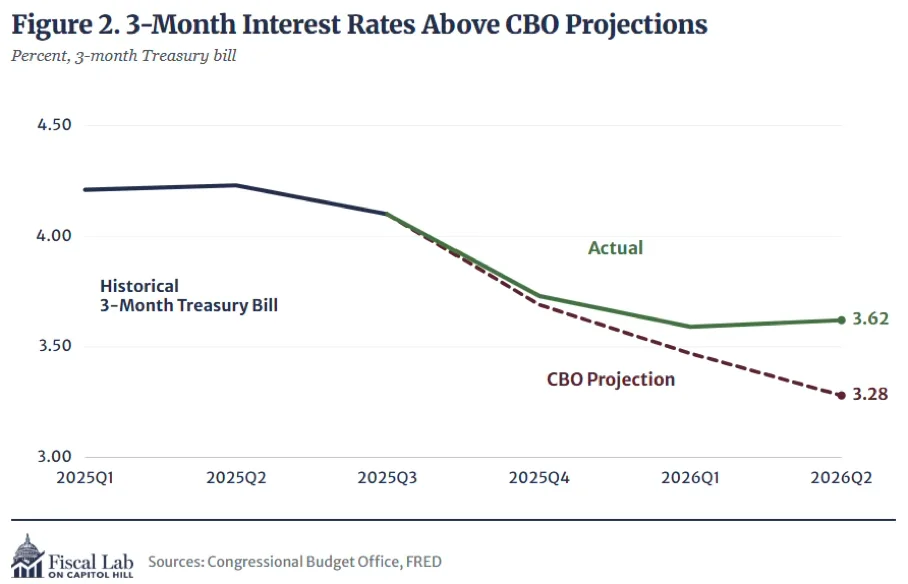
Actual interest rates were similarly higher than projected for three-month Treasury bills. The CBO projected the interest rate would be 3.47 percent in the first quarter and 3.28 percent in the second quarter. Instead, they were 12 basis points higher in the first quarter at 3.59 percent and 34 basis points higher in the second quarter at 3.62 percent.[3]
Fiscal Effects of Higher Interest Rates
Interest rates have significant impacts on the federal budget. Using CBO’s economic rule of thumb workbook, we can estimate the costs of changes in interest rates relative to the baseline.[4]
Based on the higher interest rates that have been observed this year, federal outlays would increase by an estimated $101.4 billion over the FY 2026 - 2036 budget window relative to the CBO’s February 2026 baseline.
| 2026 | 2027 | 2028 | 2029 | 2030 | 2031 | 2032 | 2033 | 2034 | 2035 | 2036 | 2026–2036 | |
|---|---|---|---|---|---|---|---|---|---|---|---|---|
| Change in Revenues | -5.2 | -0.4 | 1.0 | 0.8 | 0.7 | 0.6 | 0.5 | 0.4 | 0.3 | 0.3 | 0.3 | -0.8 |
| Change in Outlays | 12.8 | 18.3 | 11.3 | 9.7 | 8.7 | 8.3 | 7.0 | 6.8 | 6.1 | 6.3 | 6.0 | 101.4 |
| Change in Deficit | 18.0 | 18.7 | 10.3 | 8.9 | 8.0 | 7.7 | 6.6 | 6.4 | 5.8 | 6.0 | 5.7 | 102.1 |
Budgetary effects are shown in billions of dollars relative to CBO’s February 2026 baseline, using observed interest-rate deviations through the second quarter of 2026.
Source: Author calculations based on CBO model.
If interest rates remain elevated above the CBO’s baseline forecast throughout the rest of the 10-year budget window, outlays would increase by nearly $1.3 trillion over the FY 2026 - 2036 budget window.
In this scenario, the net interest costs in FY 2036 would be about $2.4 trillion, 9.6 percent ($206 billion) higher than the CBO’s baseline projection. Interest spending would be projected to grow from 3.2 percent of GDP in FY 2025 to 5 percent of GDP in FY 2036.
| 2026 | 2027 | 2028 | 2029 | 2030 | 2031 | 2032 | 2033 | 2034 | 2035 | 2036 | 2026–2036 | |
|---|---|---|---|---|---|---|---|---|---|---|---|---|
| Change in Revenues | -7.4 | -7.5 | -5.0 | -2.5 | -0.2 | 1.6 | 3.2 | 4.6 | 5.7 | 6.9 | 8.0 | 7.3 |
| Change in Outlays | 18.4 | 46.0 | 65.6 | 83.6 | 100.9 | 118.5 | 135.5 | 152.4 | 169.5 | 187.3 | 205.8 | 1,283.5 |
| Change in Deficit | 25.9 | 53.6 | 70.6 | 86.1 | 101.1 | 116.9 | 132.3 | 147.8 | 163.8 | 180.4 | 197.8 | 1,276.2 |
Budgetary effects are shown in billions of dollars relative to CBO’s February 2026 baseline, if interest rates persist at 33 basis points higher than baseline projections.
Source: Author calculations based on CBO model.
Rising Interest Costs
Treasury interest rates reflect the supply and demand for federal debt as well as factors including monetary policy, inflation, and economic growth expectations.
Since World War II, debt issued by the US Treasury has been considered the worldwide safe asset. Investors want to hold US government debt because it is expected to be repaid in full, highly liquid, and denominated in dollars, reflecting its status as the reserve currency. Investors around the world pay for this perceived safety by accepting a lower interest rate on US Treasury debt, known as a convenience yield.
However, there is evidence that the convenience yield is diminishing, as government spending grows faster than economic growth and excessive supply of debt outpaces demand. A falling convenience yield translates to higher interest rates and costs borne by American taxpayers.[5]
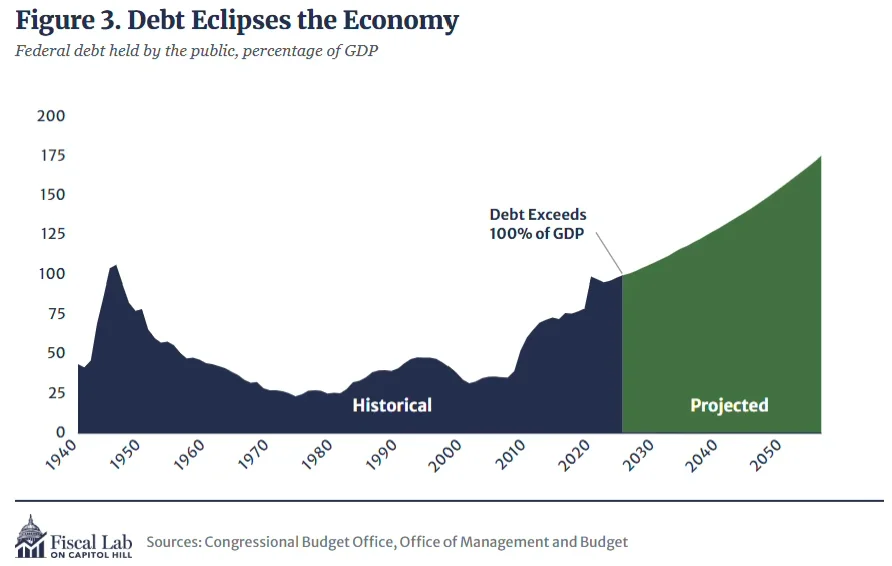
The national debt now exceeds the size of the US economy. The debt held by the public has grown to more than $31.6 trillion, eclipsing the gross domestic product (GDP) over the last year.[6] The CBO projects the debt held by the public as a percentage of GDP to surpass the post-World War II high of 106.1 percent by FY 2030. Under the current fiscal trajectory, the debt is projected to continue growing to 175 percent of GDP over the next 30 years.[7]
A larger stock of debt and higher interest rates lead to higher net interest spending. The interest costs of financing the national debt have surpassed national defense and Medicare and are now the second-largest category of spending in the federal budget, trailing only Social Security. Interest spending has grown to more than 2.5 times the pre-pandemic level, from $375 billion in FY 2019 to $971 billion in FY 2025. Interest costs already consume more than one-third of income taxes, and the CBO projects that interest outlays will be equivalent to more than 50 percent of income taxes by FY 2036.
When the level of debt is high and interest rates are high, the federal government ends up absorbing a large portion of capital available for investment from the rest of the economy. This has the effect of crowding out other investments, thereby making it more difficult for the private sector to access capital needed for economic growth. Instead of financing new innovations and increasing productivity, capital is allocated toward paying for past government spending.
Policymakers should treat higher interest rates as a warning sign. Congress should confront rising interest costs by reducing persistent deficits before debt service crowds out national priorities and imposes even larger burdens on taxpayers.
Notes
- The Budget and Economic Outlook: 2026 to 2036 (Congressional Budget Office, February 11, 2026). ↩
- Board of Governors of the Federal Reserve System, “Market Yield on U.S. Treasury Securities at 10-Year Constant Maturity, Quoted on an Investment Basis (DGS10),” dataset for 2021 - 2026, retrieved from FRED, Federal Reserve Bank of St. Louis. ↩
- Board of Governors of the Federal Reserve System, “3-Month Treasury Bill Secondary Market Rate, Discount Basis (TB3MS),” dataset for 1934 - 2026, retrieved from FRED, Federal Reserve Bank of St. Louis. ↩
- Congressional Budget Office, “How Changes in Economic Conditions Might Affect the Federal Budget, 2026 to 2036: An Interactive Tool,” last updated April 21, 2026. ↩
- Matthew Dickerson, “The Evaporating Convenience Yield Means Interest Costs Could Increase Significantly,” Economic Policy Innovation Center, April 27, 2026. ↩
- US Department of the Treasury, “Debt to the Penny,” June 30, 2026. ↩
- The Budget and Economic Outlook: 2026 to 2036. ↩