The Fiscal Lab Jobs Report for June 2026


It is likely that politicians in some quarters of Washington wanted a June jobs number close to 1776, perhaps 176.6 thousand new jobs. Afterall, the Bureau of Labor Statistics (BLS) June estimate would be published just two days prior to the Fourth of July. In fact, economists polled by news organizations expected a healthy gain above 100,000; and Revelio Labs forecasted even larger gains of 258,800 new jobs. Many also thought the US would see a temporary jump in World Cup - related employment.
In the end, the BLS, which has the last word in these matters, disappointed everyone. The Bureau announced that private and public net nonfarm employment rose by just 57,000 jobs in June. That number fell below the May and April estimates, which BLS revised downward. April fell by 31,000 from 179,000 to 148,000; and May fell by 43,000 from 172,000 to 129,000. It is not uncommon for the early estimates of job change to be revised after BLS receives more data.
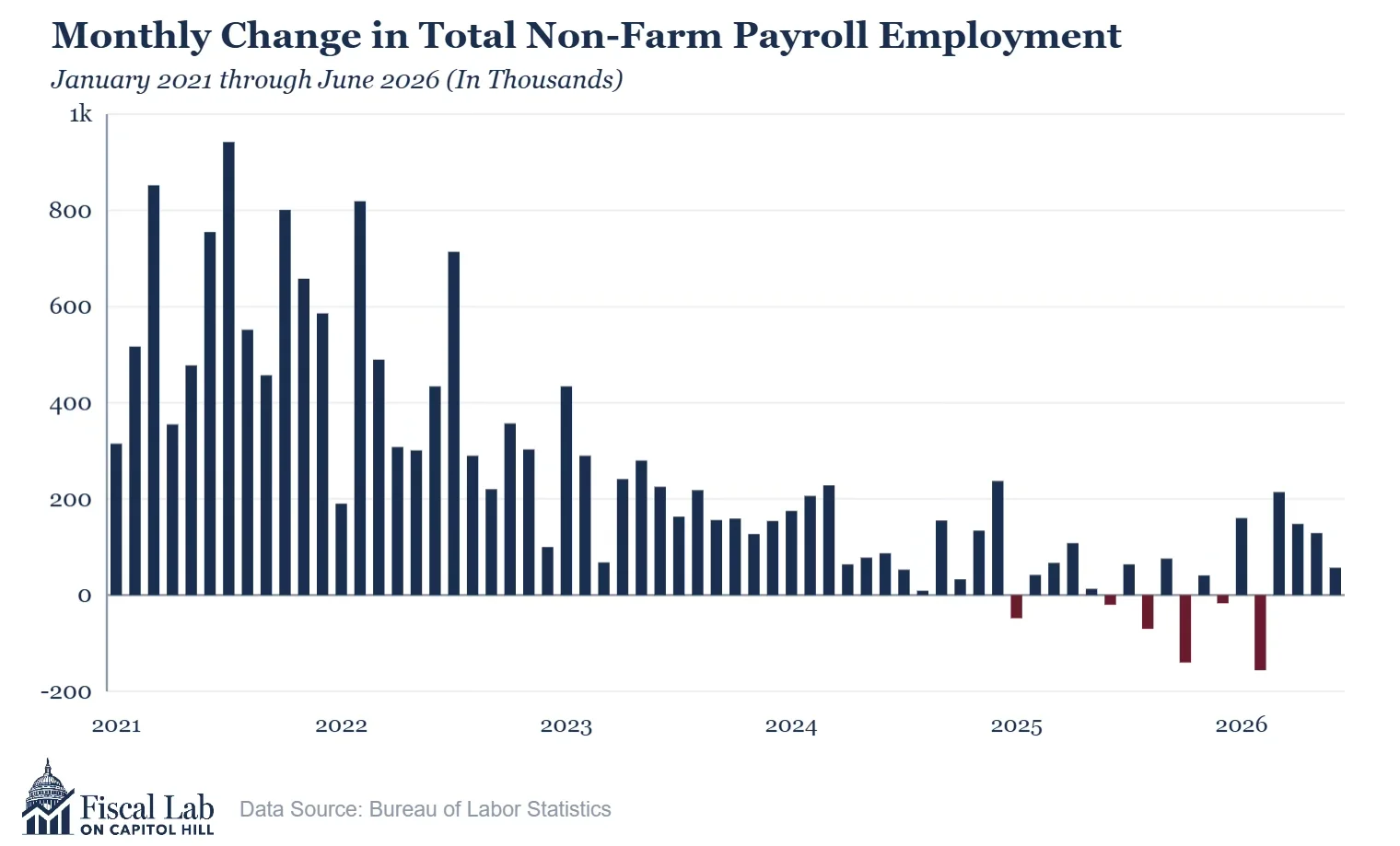
The healthcare sector once again led the pack in job gains, with 46,600 new positions. More than half of this gain (25,100) was in individual and family health care. This clearly is slated for significant growth as aging boomers decide to stay in their homes supported by private sector caregivers.
One surprise was the job decline in Leisure and Hospitality. Analysts had assumed that the World Cup would produce more employment in hotels, bars, restaurants, and tourist-related businesses. However, this super sector declined by 61,000 in June.
On the other hand, Professional and Business Services, which had been struggling in recent months, grew significantly in June: 36,000 jobs. This sector saw growth in legal services (5,100), computer systems design (4,300), consulting (7,300), and particularly in administrative and support services (21,000). This latter category contained a fascinating gain in employment services of 14,000 jobs, which perhaps signals a tightening of the job market and a growing premium on recruiting and training.
All these sectors under Professional and Business Services are vulnerable to AI transformation, and readers of this monthly Fiscal Lab Jobs Report will recall a focus on job change in the computer services sectors. Readers will also recall that we argued that AI-driven transformation there, principally in coding and design, would ultimately result in stable job growth as the sector absorbed AI technology and created new jobs around that tech. We may be seeing that expected job growth.
Workers Leave the Labor Force
One of the most interesting parts of this month’s Employment Situation Report is found in the Household Survey. BLS fields this survey on a sample of about 60,000 households. All our information on who is in and out of the labor force and who is unemployed and who they are stem from this survey. This month the Household Survey was full of surprises.
First, analysts did not expect the unemployment rate to drop from its May estimate of 4.3 percent of the labor force. However, the June reading came in at 4.2 percent. On its face, that appears to be good news: The number of unemployed dropped by 231,000 and now stands at 7,094,000.
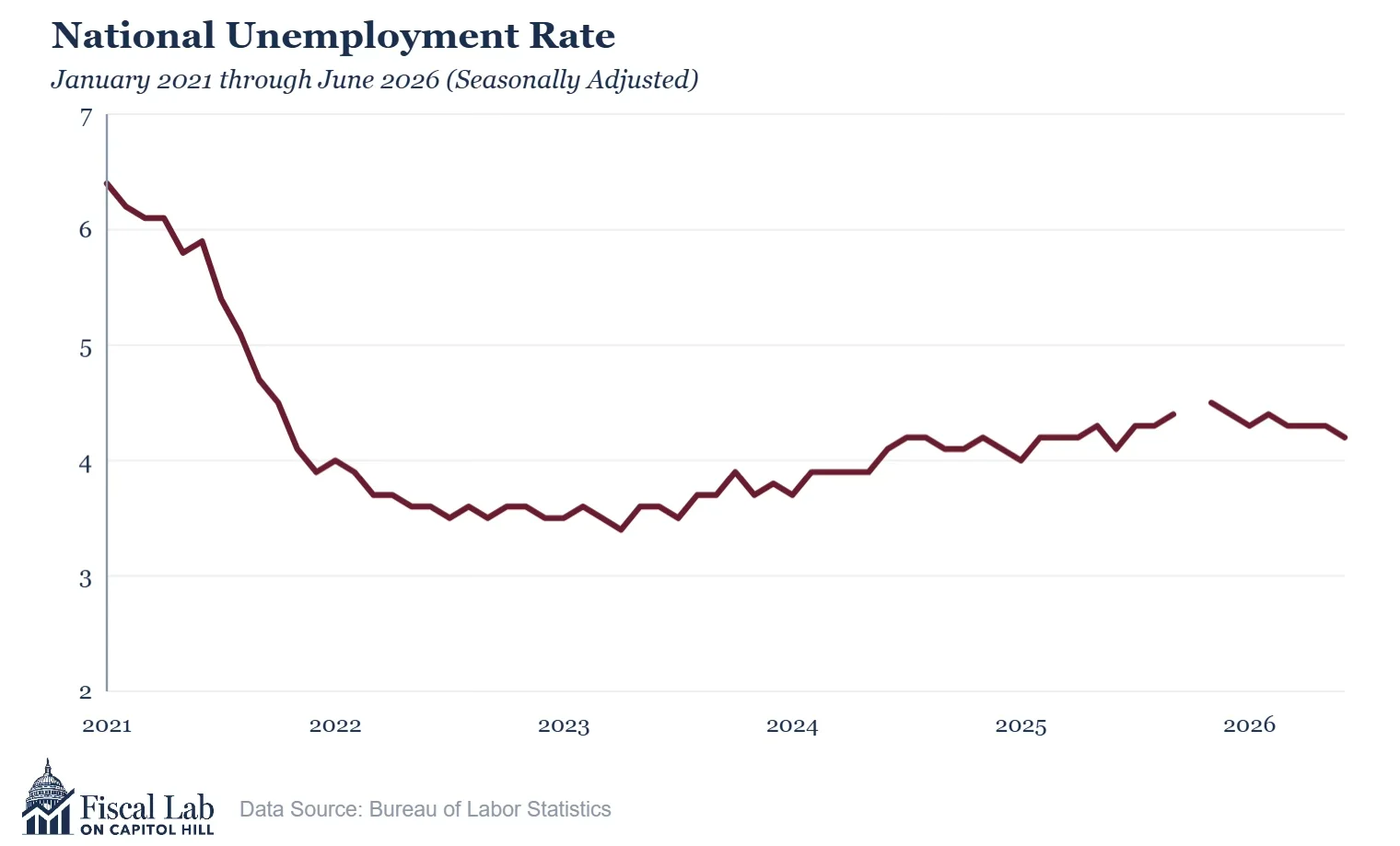
Second, this decline is very likely not due to improving job prospects but to people leaving the labor force. BLS reported a statistically significant decline in the labor force of 720,000. The threshold for statistical significance on this variable is 664,000, which means that we have a very telling movement in labor market data. At the same time, the civilian population (those people in the US aged 16 and above who are not institutionalized) grew by 112,000. Thus, the source of the labor force decline was not a drop in population.
Where did they go? The broad category of “not in the labor force” grew by a significant 832,000 in June. This aggregate covers retirees and others who are neither working nor looking for work in the four weeks prior to the survey period (a week that contains the 12th of the month). Marginally attached and discouraged workers (basically, those who have not found a job in the past year and those who have given up looking) hardly changed at all this past month. Fewer people left their jobs this past month (job leavers declined by a statistically significant 141,000). Thus, we are left with a strong suspicion that this decline in the unemployment rate is principally due to retirements.
Another Decline in the Labor Force Participation Rate
Another twist in the ongoing labor force story from the Household Survey is the decline in labor force participation. This rate measures the percentage of the civilian population that either is working or actively looking for work. One year ago, the rate stood at 62.3 percent. The June rate came in at 61.5, which is a decline of 0.3 percentage points from its May reading of 61.8. To put this in perspective, this rate stood at 66.7 percent in June of 1996, 66.2 percent in June of 2006, and 62.7 percent in June of 2016.
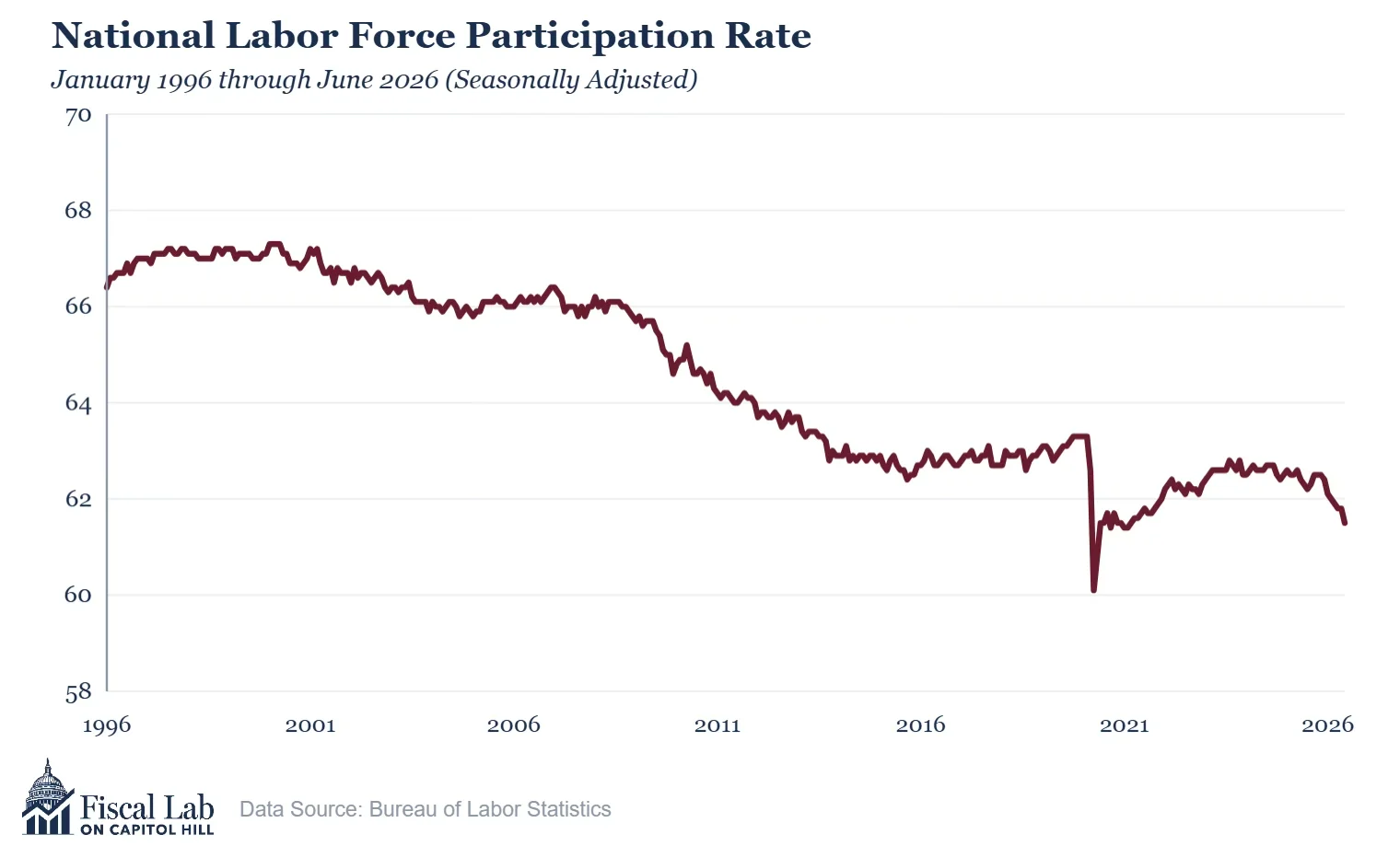
There clearly are two breaks in the series: one stemming from the period of the Great Recession and the slow recovery from that slowdown, and another from the Covid-19 crisis. These economic drivers to the participation rate coincided with the boomers reaching early and late retirement ages, and doubtless the convergence of tough economic times and demographics goes far to explain this steady decline.
That said, the decline in the participation rates of young workers aged 16 through 24 across this period is more worrying. This demographic group clearly is not affected by personal retirements, and it is fair to say that starting a career has always been among the most challenging periods of anyone’s labor market life. Even so, the decline in participation rates in this cohort is troubling.
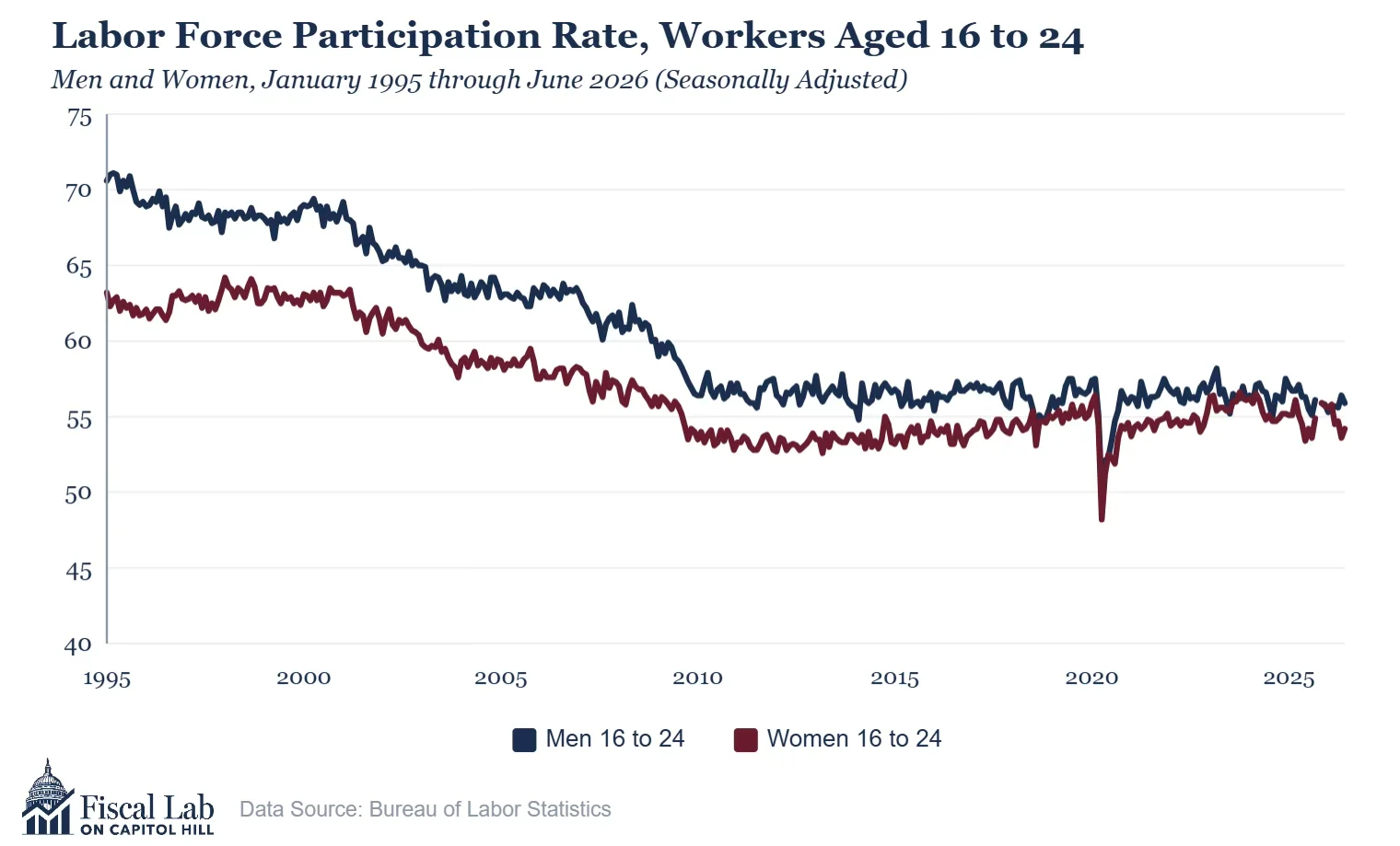
Analysts have spent significant time studying the decline in the participation rate of young men, but they have largely ignored the decline in the rate for similarly aged women. As these data show, the rates of women now mirror those of men.
Both series appear to have stabilized at a very low rate of about 55 percent in and around the Great Recession. That means that nearly half of the large demographic group is neither working nor looking for work. Some, of course, are in post-secondary school or training, but even there part-time work would be counted as participating in the labor force. Others are in the military, but this population is explicitly excluded from the civilian labor force and, thus, not eligible for inclusion in the labor force participation rate.
These data point to a large population that has either foresworn employment or cannot overcome the challenges of launching a life of work. Some insight on the challenges has been provided by the Federal Reserve Bank of New York. The Bank published a statistical study on young workers last year. It found that 41 percent of recent college graduates were underemployed (working at a job that does not require a college degree) and that 34 percent of all college graduates were similarly underemployed. The unemployment rate for all college graduates is quite low: 2.7 percent in June 2025. However, recent graduates studied by the New York Bank had an elevated rate of 4.8 percent. All young workers aged 22 to 27 years had an even higher rate of 7.4 percent.
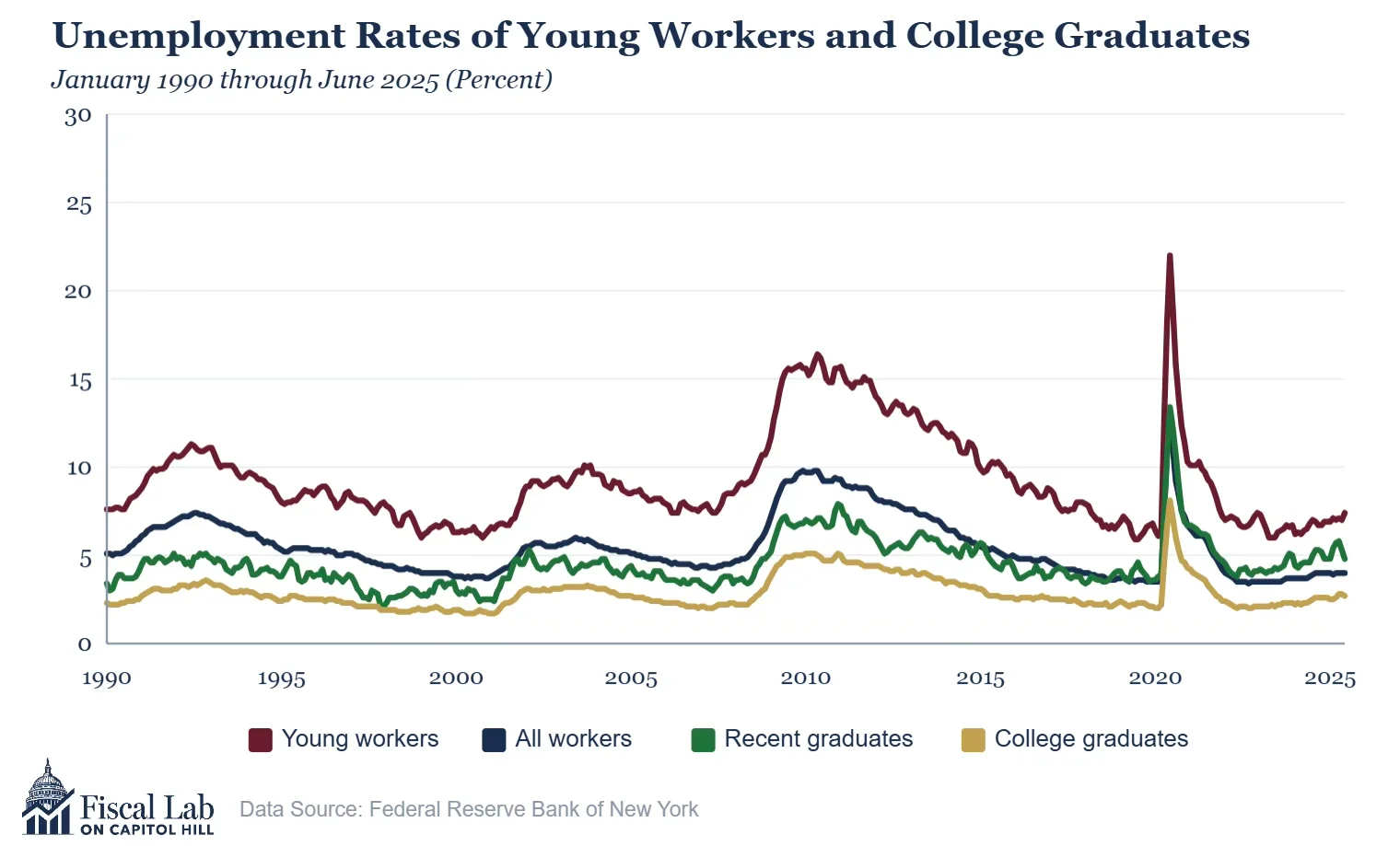
However, a young person being unemployed or underemployed still means that that person would be counted in the labor force. Thus, we are left with the deeper issues surrounding engagement with work. Also, we need to ask whether our survey work is correctly measuring how this other, seemingly disengaged half of the young cohort is spending its time. Both issues are best left to a future publication from the Fiscal Lab on work among America’s young men and women.
This is just one of many puzzles that the labor market currently presents us. The June BLS employment report disappointed some who wanted stronger numbers and clearer signals about the direction of the economy, but it did not disappoint at all in underscoring old and raising new labor market puzzles. And who doesn’t love a good mystery!